
The Tsar and His Vassals: Russia's Political Pyramid of Feudalism
Putin's Russia is better understood as a medieval feudal estate run by a mafia family in a Darwinian court - not as a modern state at all.

For years I have listened to people - many of them naive, most of them well-meaning - try to launder the crimes of Russia by pinning them on whoever happens to occupy the Kremlin. Russia is not Putin, they say. Well, you said that about Yeltsin. And Stalin. And Lenin. And the tsar. So where is this mythical other Russia, exactly, and is it scheduled to arrive in my lifetime?
I am not naive about what Russia is, and neither should you be. Putin’s eventual demise - whenever it comes, and in whatever form - will not deliver a more democratic, less violent country in his place. That is not how the Russian system works. (I have written elsewhere about the ideological software that runs underneath it.)
In the following lines, I will describe the operating structure of the Russian Federation as it actually functions - not as a modern state with authoritarian features, but as something closer to a medieval feudal estate that happens to possess nuclear weapons and a seat at the United Nations (for reasons that still bewilder me).
Let’s begin.
On 21 February 2022, Vladimir Putin held a televised meeting of the Russian Security Council. The choreography was meant to look like a deliberation with each man stepping to the microphone, asked his view on recognising the breakaway “republics” in eastern Ukraine. It was all theatre, because the decision had already been made. The point of the performance was not to debate, but to implicate every person standing in that room - to bind the Russian elite to a war they could not backtrack. Ever.
The Kremlin is not just ideology, strategy, and doctrine. There’s something more primitive in its foundation - it operates as organised crime syndicate : shared guilt as a guarantee of loyalty. Russians have a word for it - круговая порука (krugovaya poruka), circular responsibility. It is the same logic that holds a mafia family together - once everyone’s hands are dirty, no one can walk away clean.
If you want to understand why Russia behaves the way it does - why elites do not defect, why the war keeps being financed, why no obvious successor is allowed to emerge - you have to stop reading the Kremlin like a government and start reading it like a system operating rules. So here they are.
Part I The Model: Russia as Putin’s Estate
Putin does not preside over the Russian state in the way a prime minister presides over Britain or a chancellor over Germany. He treats it as personal property. Resources, ministries, industries, even people are assets in a portfolio he manages.
Because no one can run a country of 144 million people alone, he leases pieces of it out - a trusted friend gets the energy sector, a loyal lieutenant gets defence procurement, an useful technocrat gets the central bank. Each of them then extracts wealth from their territory - part of which flows back to Putin in the form of palaces he doesn’t officially own, apartments bought for people in his circle, salaries paid to relatives who don’t actually work, and money quietly moved into jurisdictions outside Russia.
THE CORE BARGAIN
Putin gives his inner circle the right to enrich themselves from the state.
In return, they pay tribute, demonstrate loyalty, and absorb personal risk on his behalf.
Officially, Putin owns very little. In practice, he is the largest beneficiary of an economy organised around his protection.
Once you accept this frame - Russia as an estate, not a federation - everything else falls into place. The clans are not factions in a normal political sense, but franchisees. The bureaucracy is not a neutral apparatus, but the staff that runs the estate. And the war in Ukraine is not, primarily, a foreign policy. It is the most expensive thing the estate has ever done, and the rules of the estate are bending under the weight of it.
Part II The Pyramid: Who Actually Holds Power
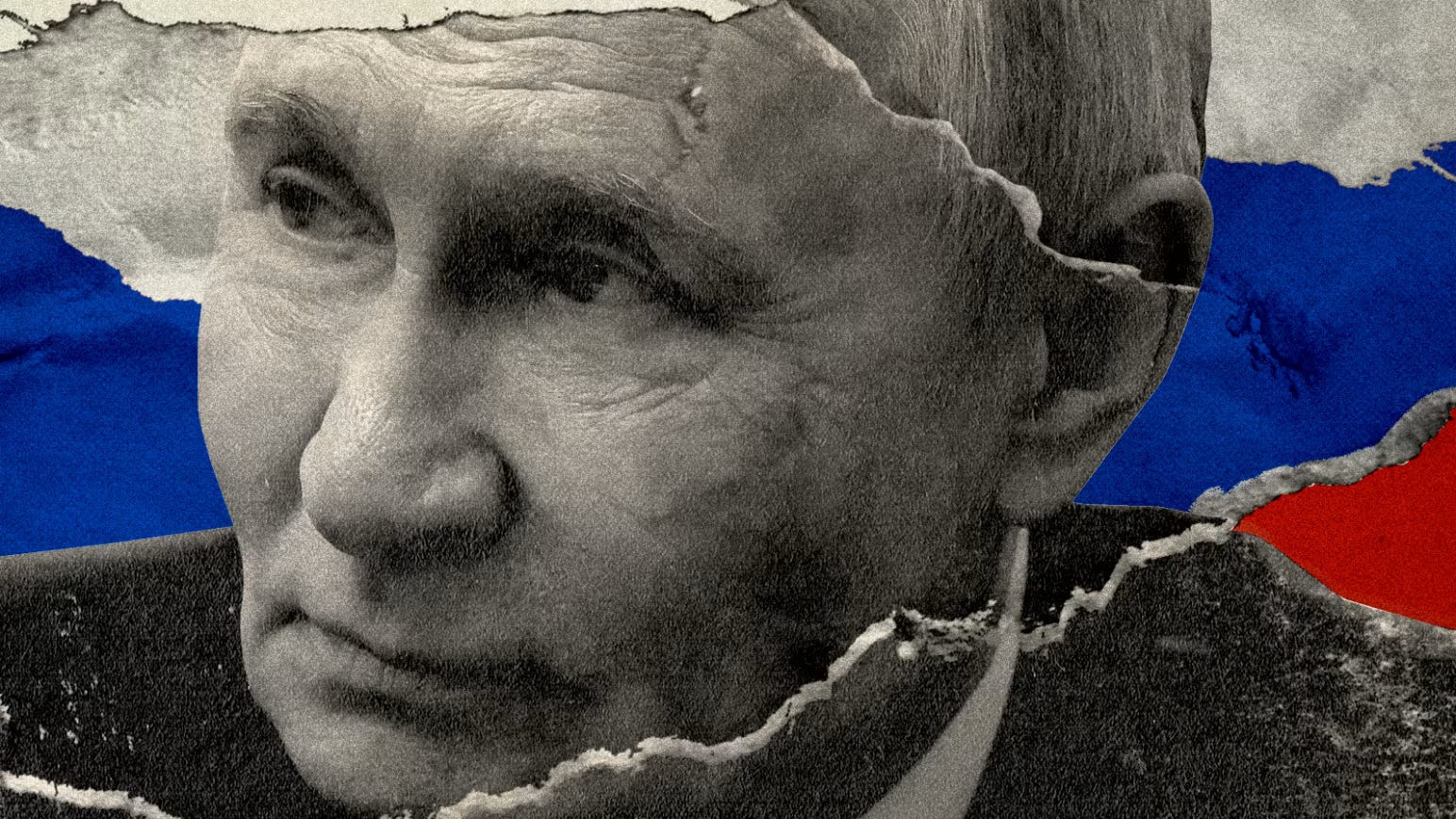
If you picture a pyramid, Putin is at the top. Below him, the system splits into four layers. Each layer has a specific function, and each is structured to ensure that no single layer can act against him without the others noticing.
Layer 1: The Clans
There are roughly five major clans, each one is built around a patron - a man with decades of personal access to Putin - who acts as the head of an extended client network. Clans control the strategically critical pieces of the Russian economy: defence, agriculture, transport, energy. They place their people in ministries, push laws favourable to their assets, and lobby Putin on personnel decisions.
The single most valuable currency in the system is not money, but access. A clan boss who can still get a meeting with Putin is powerful. One who cannot, no matter how rich, is a bottom feeder.
Layer 2: The Independent Putinists


Below and slightly to the side of the clans sit a smaller group of figures who do not belong to any particular network but who serve Putin directly. They are technocrats, managers, useful specialists. Dmitry Medvedev - the vodka marinated brain that cosplayed as president at one time (he blocked me on Twitter for calling him that, btw). Mikhail Mishustin - the prime minister and tax-system technocrat. Ramzan Kadyrov - the Chechen warlord who provides Islamist fighters for Putin’s wars in exchange for federal money. Alexei Miller at Gazprom, etc.
And then there is Elvira Nabiullina, the head of the central bank - arguably the single most operationally important person in the system not named Putin. She is the reason the rouble did not collapse in 2022. She is the the financial sorceress behind Russia’s ability to finance the war in Ukraine without getting crushed by the numerous sanctions.
Layer 3: The Security Services
Beneath the clans and the technocrats sits the apparatus that actually enforces loyalty: the FSB, the Investigative Committee, the Prosecutor General’s office, and the various other security organs. Their job is not to defend Russia from external enemies. Their job is to keep dossiers on every member of the Russian elite - every affair, every offshore account, every corrupt deal - and to remind those elites that the dossier exists, in case they get funny ideas.
Layer 4: The Family
And then there is the crime family. Putin’s daughters, Maria and Katerina, both work in suspiciously interesting fields. Maria, the elder, is in personalised medicine and diagnostics. Katerina, the younger, is in biotechnology and technical innovation. The official explanation is national security - Russia must, after all, defend itself from the genetic weapons the West is supposedly designing to kill ethnic Russians. The actual explanation is more mundane and more revealing. Putin is 73. He wants to live longer and his daughters are working on it. Remember that hot mic moment in Beijing, when Putin eagerly expressed his desire to live until 150?
The wider family network spreads further. Anna Tsivilyova, the daughter of Putin’s cousin, was made deputy minister of defence in 2024 - with responsibility for the social welfare of war veterans. Her husband, Sergey Tsivilyov, was made minister of energy at the same time. These appointments are not coincidences, but the eyes and ears in two of the most consequential ministries in the country. They are also, almost certainly, figureheads holding assets that belong, in everything but name, to Putin himself.
THE PYRAMID, IN ONE SENTENCE
Putin sits alone at the top, surrounded by clans that compete for his favour, technocrats who keep the machine running, security services that watch everyone including the clans, and family members who hold his real wealth - and no one in the structure can act independently without being seen by at least two of the others. Круговая порука.
Part III The New Elite: Manufacturing a Wartime Aristocracy
Here is where the system stops being static.
Putin is in the middle of an explicit project to build a new ruling class. He calls them the veterans - the patriotic elite forged in the war - and he contrasts them with what he describes as the cosmopolitan, unpatriotic elite of the 1990s. The oligarchs who got rich during the post-Soviet privatisations. The people who, in his telling, sold Russia out.
This rhetorical move does several things at once:
• It manufactures heroes. Returning soldiers are paraded as the moral backbone of the new Russia, useful for propaganda and useful for legitimising the war.
• It disciplines the existing elite. The implicit message: behave, or you will be replaced by men who fought while you stayed comfortable.
• It propagandises social mobility. Russians from poor regions are shown that combat is a path upward - even if the actual path tends to lead to an early grave.
• It locks in the war. People who lost limbs and brothers at the front have a powerful interest in not seeing that war declared a mistake.
In practice, the new elite project is - like most things in Russia - mostly theatre. Veterans who actually served on the front line are slotted into junior positions in regional administrations and lower-tier elected bodies, where there is little real money and even less real power. The old elites are not letting newcomers anywhere near the actual assets. What veterans get instead are propaganda functions: speaking in schools, teaching children to operate drones, leading patriotic-education programmes, etc.
And there is a darker subplot. Some of the most prominent “veterans” rising through the system never saw real combat at all. They held positions in the bureaucracy, took a brief tour through a special unit, and returned with the prestige of front-line service and a fast-track to promotion. The system is producing the appearance of a meritocratic warrior class while continuing to reward the same people it always rewarded.
WHY THIS MATTERS FOR THE WEST
If the war ends, the propaganda value of the new elite collapses with it. The Kremlin needs the war to keep the project alive. This is one of the structural reasons - separate from the question of territory or ideology - that any negotiated settlement is harder than it looks. A peace deal does not just end a conflict, but dismantles a domestic political construction that Putin has spent three years building.
Part IV: The Succession Question
Every member of the Russian elite knows that Putin will eventually be gone. Despite his daughters’ best efforts, he is mortal. The system around him is built on his personal authority. So, quietly and without public acknowledgement, the elite is preparing for two things at once: surviving inside the current system, and positioning themselves for the moment after.
This is the contradiction at the heart of Russian high politics today. To be useful to Putin now, you must show no ambition. To be useful to yourself later, you must accumulate exactly the kind of power Putin punishes. So everyone walks the line.
The Names to Watch


Below are several names worth keeping an eye on:
Nikolai Patrushev - for years considered the de facto number two, with hardline security-services credentials. Dismissed as Secretary of the Security Council in 2024. Whether this was a quiet retirement or a quiet warning depends on whom you ask.
Yury Kovalchuk - the leader of one of the most powerful Kremlin clans, and reportedly one of the figures whose isolation with Putin during COVID influenced the decision to invade Ukraine. Ideologically aligned with the most militaristic faction of the elite.
Mikhail Mishustin - the prime minister, who is constitutionally next in line. He is also a competent technocrat with no political base and no clan. In other words, exactly the kind of placeholder Putin trusts because he cannot threaten.
Dmitry Patrushev, Alexei Dyumin, Sergei Sobyanin - the long-listed names. Sobyanin runs Moscow, the most administratively powerful sub-national post in the country. Dyumin is a former Putin bodyguard and now occupies senior security posts. Patrushev junior is the son of Patrushev senior - Russian-style dynastic politics.
Sergei Kiriyenko - the most interesting name on the list, and the one I would watch most carefully. Briefly prime minister in the 1990s. He spent years running Rosatom, and is now deputy head of the presidential administration, where he has quietly taken control of domestic political management, online propaganda, the occupied Ukrainian territories, and elements of foreign policy in the post-Soviet space - South Ossetia, Abkhazia, Transnistria. He organised the annexation referendums of autumn 2022.
It’s worth remembering that Russian high politics under Putin does not reward overt ambition. The moment a player rises too visibly above his station, someone is dispatched to clip his wings. Whether this happens to Kiriyenko - and how - will tell us a great deal about whether the post-Putin transition is being planned or simply being postponed.
Part V: How the System Disciplines Its Own
The most useful question to ask about any authoritarian regime is not why people support it, but why people who privately oppose it do not act on that opposition. In Russia, the answer has three parts.
1. Money
Despite what the sanctions optics suggest, the Russian elite is still making a great deal of money. The war economy means swollen defence contracts, federal budget grants, and lucrative roles in the now-nationalised industries. Members of the elite have learned how to dip in these flows and route the proceeds into private accounts. Sanctions have hurt some of them, but most have adapted.
And the West has been, at best, inconsistent. Valentina Matviyenko, chair of the Federation Council and a sanctioned individual, was permitted into Switzerland last year for a UN meeting where she spread Kremlin talking points uncontested. The lesson the Russian elite draws from this is straightforward: Putin is still effective enough as a patron that the costs of staying loyal are bearable.
2. Fear
The FSB has a file on every one of them. I guarantee you that much. Every affair, offshore vehicle, every conversation that should not have happened, there is a paper trail of it somewhere. The threat is not that the file will be made public, but that the file exists at all - and that the rules for when it gets used are deliberately unwritten.
Members of the elite do not trust each other. The post-Soviet ruling class is, in its bones, a Darwinian environment where everyone has spent 30 years watching peers be destroyed for stepping out of line. Solidarity among them is structurally impossible to organise.
3. Property Rights
This is the change that has accelerated since 2022, and it is the most important development inside the Russian system that almost no one outside it is paying attention to.
Under cover of an “anti-corruption” campaign, the Russian state has begun confiscating private assets at an unprecedented scale. Companies privatised in the chaotic 1990s are being investigated 30 years later. The prosecutor’s office declares the original privatisation invalid, the asset is taken from its current owner and either nationalised or transferred to a Kremlin-aligned clan. 805 Russian companies have been nationalised through the courts, according to the Federal Agency for State Property Management.
The legal pretext is fighting corruption, but the actual function is two-fold. First, it generates revenue for a federal budget that is straining under the cost of the war. Second, and more importantly, it is a tool of discipline. Every member of the elite now understands that their property rights are conditional, that the rules can be reinterpreted retroactively, and that the only protection is active, visible, ostentatious loyalty.
THE NEW RULE
The old deal was: be loyal, steal within agreed limits, stay out of politics, and your wealth is safe.
The new deal is: there is no agreed limit, the line moves without warning, and only zealous demonstrations of loyalty buy temporary protection.
Part VI: What Happens When the Music Stops
The Russian system is currently held together by three things: the war, the propaganda of besieged-fortress nationalism, and the personal authority of Vladimir Putin. Subtract any of them and the structure becomes unstable.
If the war ends - through negotiation, exhaustion, or any other route - the rationale for the wartime mobilisation evaporates. The cuts to social spending become visible. The questions about what the war actually achieved become unavoidable. The new “veteran elite” loses its political function. The disciplinary tools sharpened during the war - asset seizures, retroactive privatisation reviews, the FSB dossiers - start to feel less like wartime measures and more like the way the country now works in peacetime, which is a much harder thing to justify.
When a severe economic crisis arrives - driven by sanctions, burning oil refineries, the loss of access to African gold and uranium mines, or the simple reality that you cannot run a war economy indefinitely - the assets the elite have been fighting over begin to shrink. Internal competition among the clans, currently moderated by the prospect of continued growth in the war pie, becomes a zero-sum game.
And if Putin loses the physical capacity to govern - the question that nobody at the top of the Russian system is allowed to ask out loud - the absence of an agreed successor means a power struggle. Each clan has its own armed assets. The Wagner mutiny in 2023 was a warning shot, badly handled and quickly resolved, but it confirmed something important: the men around Putin can, in extremis, mobilise force.
None of this is a prediction of imminent collapse. The Russian system has survived shocks that should have broken it. It is more durable than its critics tend to believe. But it is also more fragile than its supporters tend to admit, because the things that hold it together are increasingly the same things that are wearing it out.
My Balkan Candor
People in the West keep asking the wrong question about Russia. They ask why the elite does not stop Putin. The question assumes the elite is something separate from Putin. It is not. It is the staff of a privately-held estate. Their wealth, their families’ wealth, their personal safety, and their freedom from prosecution are all functions of his survival.
The Russian system is not a government with a strongman attached. It is a strongman with a government attached. And the most important thing happening inside it right now is not the war - it is the slow, deliberate, increasingly arbitrary rewriting of the rules that hold the structure together. Putin is using the war to discipline his own ruling class, and he is succeeding. He is also burning through the trust and the property rights that made the system functional in the first place.
The interesting question is not whether the Russian system collapses. It is whether what comes after it is more dangerous, less dangerous, or simply different in ways we have not yet imagined.
If you find yourself in conversation with someone who tells you confidently what post-Putin Russia will look like, ask them which of the five clans they think wins. If they cannot name one, they are not actually answering the question.