
21st Century Battlefields: Oceans, Space & Cognition
Modern war runs through your shipping lanes, your satellites, and your sense of what's real - and it's disguised as peacetime.

War never stopped evolving - it has simply evolved into a form most people can no longer recognise as war. It has moved off the battlefield you picture, and onto the three systems a modern civilisation actually runs on: the oceans that carry its goods, the orbital and undersea infrastructure in space and on the seabed that carry its data, and the information space that carries its beliefs - its very sense of what is real.
Ask the average person to picture “war” and you get, more or less, a the same picture: tanks rolling into a city, soldiers in the streets, a flag coming down and another going up. War, in the popular imagination, is a thing that violently arrives, with a well-defined beginning you can point to.
The trenches of Ukraine, paradoxically, have made this misconception worse, not better. When people see the mud, the artillery, the WWI-style attritional grind along the Donbas, it confirms the mental model: ah, yes, THAT is war. That is what war looks like. And by confirming it, it quietly files everything else - the cut undersea cable, the jammed satellite signal, the viral lie - under some lesser category of “escalating tensions”, “incidents.” or “hybrid stuff.”
This is a catastrophic error, and it is, I’d argue, partly an engineered one. Because if you believe war is only war when tanks are in your square, then a great deal can be done to you - your trade strangled, your infrastructure sabotaged, your population turned against itself - and you will keep insisting, right up until the lights go out, that you are living in peacetime.
The evolution: war always migrates to where the value lives
There is a principle that organises 2,000 years of military history: the decisive battlefield of any era sits wherever that era concentrates its wealth and power - and wherever that concentration is most vulnerable.
War is not conservative, it does not cling to old methodologies out of sentiment. It is the most ruthlessly pragmatic activity humans engage in, and it follows value the way an apple falling from the tree follows the laws of gravity.
In the agrarian age, value was land and the people who worked it. So war meant taking territory, sacking cities, capturing or killing people. The town square genuinely was the battlefield, because the square was the wealth. Tribes became city-states became empires, and the logic held steady for millennia: control the ground, control everything that grows on it.
The industrial age moved the value to productive capacity: factories, railways, steel, oil. The Second World War is the pinnacle of this transition - the first truly total mechanised war, in which the entire industrial base of a nation became a legitimate target. You no longer won by defeating an army in a field, you won by outproducing them, while bombing the factories, the railways that carried the ammo and resources, the refineries, the cities that housed the workers, etc. This is the moment the home and the front first dissolved into each other - the factory worker in the city and the soldier at the front were, for the first time, on the same battlefield. Mechanised warfare erased the line between combatant and civilian, because in an industrial war, the civilian economy is the war machine.
Then came the second half of the 20th century: the nuclear bomb.
Nuclear weapons made direct war between great powers suicidal. Mutually Assured Destruction displaced great-power conflict by making a direct fight between rivals impossible without ending the world.
The Cold War’s answer to this dilemma was the proxy war. Korea, Vietnam, Afghanistan, Angola, Nicaragua - superpowers waging a world war on other people’s turf, because they could not wage it on their own. Proxy war was a geographical displacement: you can’t fight in Washington or Moscow, so you fight in Kabul and Saigon.
The logical conclusion is that war is inevitable, and once direct conflict becomes too costly, war does not stop, it just evolves.
And here we arrive at our current time, which is simply the second great displacement. Cold War 1.0 relocated conflict in geography via proxies, the 21st century warfare relocated it in category - it moves conflict below the legal and conceptual threshold of “armed conflict,” into a permanent grey zone where it can run continuously, against everyone, including nations formally at peace. Same logic as the Cold War, just one level more abstract. The Cold War 1.0 couldn’t be fought in the capitals, so it moved to the jungles. Cold War 2.0 can’t trigger Article 5, so it moves to the seabed, to orbit, and into your head.
Why this particular restructuring of warfare? Because the value moved again, and war, as ever, followed where value is in order to destroy it.
The wealth and power of the 21st-century is no longer primarily its land (agrarian) or even its factories (industrial), but in is its connective tissue - the flows that let a globalised civilisation function to begin with. The movement of goods across the oceans, data through space and under the sea, and belief through the information space. Pre-modern war seized stocks: land, gold, cities - things you can stand on, while war attacks flows - things you can only strangle to inflict damage to your opponent. How long do you think that the civic order of the United States, France, Belgium or China will endure if the flows of good and services suddenly stops, the shelves empty out, and people that are used to prosperity become poor overnight? That’s the war we are in.
And this is the part that should genuinely change how you read the news: you no longer need to conquer a country to defeat it (Russia is an exception to this rule, for ideological reasons). You need to make it decline in economic power. And that turns out to be staggeringly, almost insultingly, cheap.
The return on investment of sub-threshold warfare is the highest in the history of organised violence. A dragged anchor that costs a few hundred thousand dollars can sever cables carrying billions in daily traffic. Six men with severed pig heads and a budget flight can inflame two religious communities across a continent and dominate global headlines for weeks. A piece of malware pushed through one misconfigured server can disable tens of thousands of devices across multiple countries. You do not do this despite its being cheap, you do this because it is cheap, deniable, and destructive - and because, unlike a tank in a square, it does not start a total war you cannot afford to finish (like Russia did in 2022).
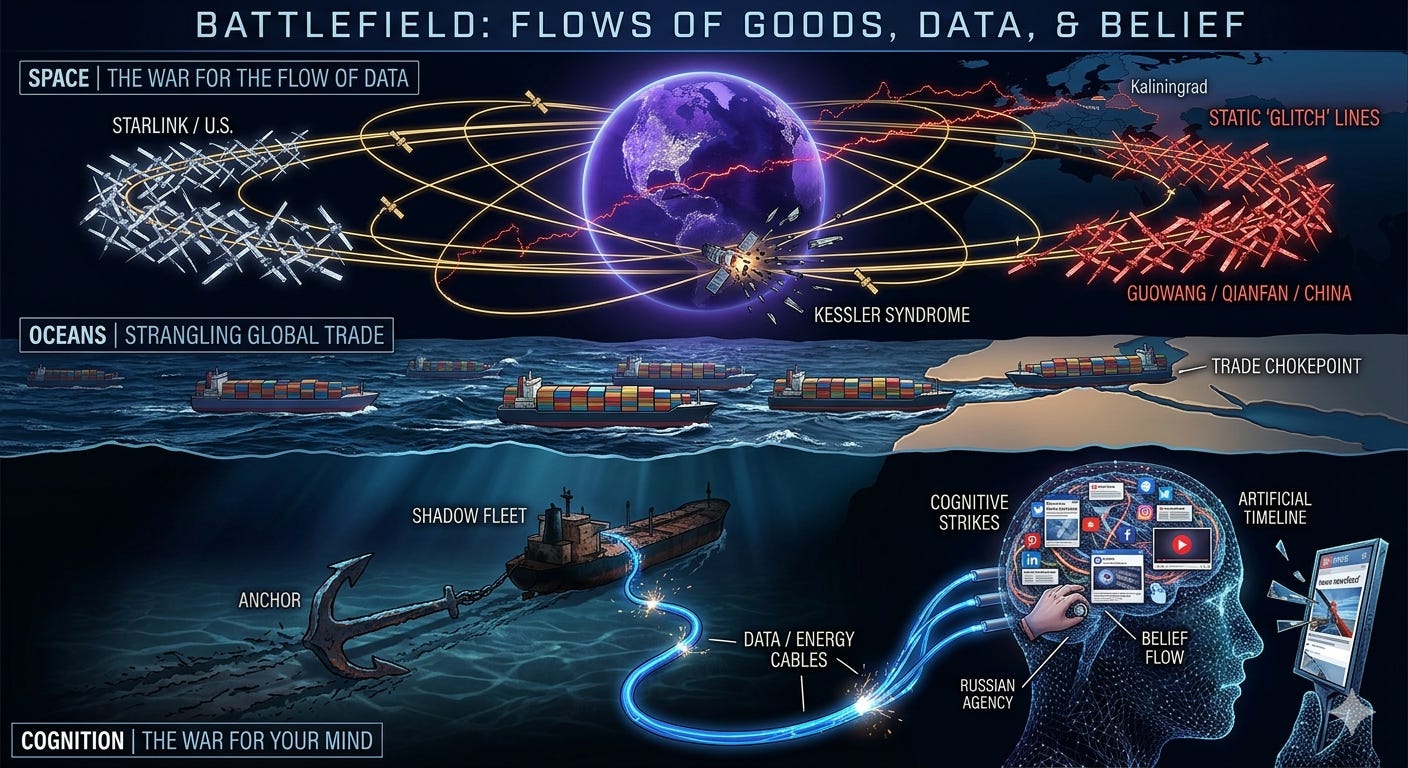
Battlefield One: The Oceans, strangling the flow of goods
Roughly 90% of everything you own, ate this week, or are wearing right now travelled to you across the ocean. The global economy is not, fundamentally, a thing of factories and offices. It is a thing of cargo ships - tens of thousands of them, moving in patient lines across a handful of dangerously narrow corridors.
The entire global trade has several points of failure, a.k.a. chokepoints. The Strait of Hormuz, the Suez Canal, Bab-el-Mandeb, the Strait of Malacca, and the Panama Canal, the Bosporus, the Strait of Gibraltar. These are the arteries of world trade, and like all arteries, they can be clogged. The Houthis demonstrated this asymmetry: a non-state group, armed with cheap drones and missiles, turned one of the planet’s busiest trade routes into a corridor that major shipping lines simply stopped using, and insurance companies declined to insure - rerouting around the entire continent of Africa, adding weeks and billions in cost.
Cheap weaponry against a trillion-dollar artery. Are you entertained yet at the fragility of globalisation?
This is also why a country like China takes such a persistent interest in the Panama Canal and in port infrastructure worldwide. Control of a chokepoint is not something you only exercise in wartime (as we now see with the Strait of Hormuz being controlled by the IRGC), but a leverage you accumulate in peacetime, and weaponise for sub-threshold warfare.
But chokepoints are the visible part. The truly under-appreciated battlefield is beneath the ships.
About 99% of the world’s intercontinental data - your banking, your messages, the very essay you are reading right now - travels through hundreds of fibre-optic cables lying on the ocean floor.
The Baltic Sea has become a very visible example for what happens when an adversary notices this. Since the start of 2025 alone, multiple undersea cables there have been damaged. Investigators keep finding the same signature: an anchor-drag trail scarring the seabed for dozens of kilometres - in one case, a trail estimated at nearly 100 km - leading back to a vessel from Russia’s shadow fleet, the ramshackle armada of sanctions-dodging tankers and cargo ships that have become the deniable instrument of seabed sabotage. The Eagle S, a Cook Islands–flagged tanker that had departed from a Russian port, is believed to have dragged its anchor far enough to knock out a power cable and four data lines off the coast of Finland. NATO was alarmed enough to stand up an entire mission, Baltic Sentry, specifically to patrol this.
The thing is, sabotage of this kind is nearly indistinguishable from an accident. Ships drag anchors by mistake sometimes, and weather happens. So when a vessel just so happens to drag its anchor across exactly the right stretch of seabed, the operator can shrug and say “rough seas,” and prosecutors are left trying to prove intent - which is often impossible. Several of the 2025 Baltic cases were officially ruled accidental, attribution unproven. That ambiguity is the operation succeeding. It is the maritime version of drowning the truth in noise: keep it deniable, keep it below the threshold, and watch your adversary tie itself in knots trying to decide whether it has even been attacked.
The same seabed carries our energy. The Nord Stream pipelines, whatever you believe about who destroyed them, proved the vulnerability spectacularly. The Balticconnector gas pipeline - Finland and Estonia’s only non-Russian gas link - was knocked out for six months by a dragged anchor, reversing years of painstaking work toward energy independence in a single night. Offshore platforms, interconnectors, the entire submerged nervous system of modern energy: all of it sits exposed.
And there is a new ocean opening up as we speak - as the Arctic ice melts, the Northern Sea Route is becoming navigable - an entire new trade corridor, with new chokepoints, new seabed cables, new drilling, and new resources, being born into contestation in real time. Russia holds the dominant icebreaker fleet and a long militarised Arctic coastline; China has begun branding itself a “near-Arctic state”, and the current U.S. administration had voiced its’ desire to annex Greenland. We are, quite literally, watching climate change manufacture a brand-new battlefield, and the powers are already moving their pieces onto a board that did not exist a generation ago.
The ocean, in other words, is no longer a peaceful expanse between countries, but a contested medium through which the physical economy flows.
Battlefield Two: Space, the war for the flow of data
If the ocean carries the goods, space carries the nerves. And the war there is further along than most realise.
SpaceX’s Starlink has, in a few short years, gone from a broadband product to load-bearing strategic infrastructure. It has launched well over 10,000 satellites - with thousands more approved - and in doing so has effectively colonised the prime low-Earth-orbit real estate. Everyone else now has to launch higher (worse latency) or lower (brutal atmospheric drag), because Starlink got there first and filled the space.
China looks at this and sees orbital encirclement - a single American company, run by a single unpredictable man of questionable ketamine habits, owning the high ground above the entire planet. So Beijing is racing to build its own: Guowang, a state constellation of roughly 13,000 planned satellites run by China SatNet, and Qianfan - “Thousand Sails” - aiming at well over 14,000. The Western press lazily calls Guowang “China’s Starlink”.
Starlink is a commercial product that the Pentagon bought into, through a hardened military variant called Starshield. Guowang is the inverse. It was filed with the International Telecommunication Union as a state-owned project from day one, and Chinese state sources have said openly that it will carry not just broadband but laser communications, synthetic-aperture radar, and optical reconnaissance - fused into one constellation. Underneath all of it runs the Digital Silk Road logic: whoever wires the unconnected Global South owns its data backbone, and ownership of a nation’s data is a form of dominion that no 20th-century empire ever dreamed of.
Which brings up the quietly astonishing fact buried in the Ukraine war: the communications backbone of a hot conflict is now privately owned by a single billionaire. When Elon Musk could decide whether or not Starlink would function over a given battlefield, he was exercising a node of wartime decision-making that for the entire prior history of the state belonged to states. Privatised critical infrastructure has produced a situation where a CEO’s mood is a strategic variable.
There are several layers of threats associated with the space domain:
Threat #1: jamming and spoofing. The lowest, most constant, most deniable layer - interfering with the signals satellites send and receive. GNSS (GPS) interference over the Baltic has been traced to Russian facilities in Kaliningrad. This is the background radiation of modern conflict, happening every single day, degrading navigation for everyone in range, civilian and military alike. Expect more and everywhere. It is cheap, it is reversible, and it is almost impossible to pin down.
Threat #2: cyber. You do not need to touch a satellite to kill it - you attack the ground segment, the modems, the supply chain. Remember Viasat? One hour before Russian tanks crossed into Ukraine in February 2022, malware known as AcidRain entered the KA-SAT network through a misconfigured VPN and “wiped” tens of thousands of modems, rendering them permanent bricks. It severed Ukrainian military command-and-control at the exact moment of invasion - and it spilled across borders, disabling the remote monitoring of nearly 6,000 wind turbines in Germany as collateral. Around twenty governments, along with researchers at SentinelLabs, attributed it to Russia’s GRU - the Sandworm cluster. It remains one of the most consequential cyberattacks ever formally attributed to a state.
Threat #3: rendezvous and proximity operations. This is the new frontier, where satellites maneuver, closing in on other satellites. Russia’s Luch/Olymp craft have spent years parking themselves beside military and commercial satellites; France openly accused one of espionage after it cosied up to a French-Italian military comms bird. The trap is that the exact same technology that lets a satellite refuel another, inspect it, or clear debris also lets it grab, jam, or disable one. Intent is unverifiable from the ground. A repair robot and a weapon look identical until the instant they don’t. And it is escalating fast: that episode of Russian satellites cornering a commercial radar sat over Ukraine is the leading edge, and the West is responding in kind - France is fielding “patrol” satellites by 2027, Japan is building what it frankly calls “bodyguard satellites.” An orbital arms race is not coming. It has started.
Threat #4: doomsday, kinetic kill, and Kessler. And here is where space stops being like any other battlefield and becomes something genuinely without precedent.
Blowing up a satellite is nothing like blowing up a tank. The wreckage does not fall down and stop. It stays up - thousands of fragments, each travelling at orbital velocity, each now effectively a bullet. Those bullets hit other satellites, which shatter into more bullets, which hit more satellites. It’s basically a runway chain reaction, described as the Kessler Syndrome, and it is the closest thing the space age has to a doomsday device.
I’ve heard it described as “like nuclear war, but worse, because there’s no control”. A nuclear weapon has a blast radius and an end; the detonation finishes. A debris cascade has no off-switch, no borders, and no winner. Depending on the altitude and scale, it can render entire orbital bands unusable for decades - not just for the target, but for the attacker, for every neutral nation, for the whole of humanity. Worse: a dense enough debris field can block launches through that altitude, sealing off the higher orbits above it. You could, in a single act of aggression, lock the human race out of space.
It is the only weapon I can think of where pulling the trigger guarantees that you also lose. And the margin is already thinning without a shot fired - orbit now holds more than 10,000 active satellites, and the first weeks of 2026 alone generated some 1,500 collision-warning messages. We are crowding the very thing we depend on, and a single reckless escalation could foreclose it for generations.
Which is why the most important threat may be the legal one. Russia has formally told the United Nations that Western commercial satellites aiding Ukraine are fair game. In October 2022, at the UN First Committee, the diplomat Konstantin Vorontsov declared that “quasi-civilian infrastructure may be a legitimate target for a retaliatory strike.” And because the Outer Space Treaty does not actually govern any of this, there is a legal vacuum wide enough to drive any justification through. The doctrine is built, like everything else in this war, to keep the threshold ambiguous - to let Russia act while leaving you unsure whether you’ve even been hit.
Battlefield Three: Cognition, the war for the flow of belief
And now we come to the battlefield that is not around you, and not above you, but inside you. This is the one I know best, and the one that frightens me most, because it is the only domain where the terrain being fought over is your own mind.
I have written before, at length, about the mechanics of Russian propaganda - the breadcrumb trails, the 80/20 ratio of truth to distortion, the troll factories, the firehose, the way the whole apparatus is engineered to make intelligent people feel they discovered a conclusion that was, in fact, planted for them to find. (If you haven’t read “A Field Guide to Russian Propaganda,” start there; this is the sequel.)
In September last year, nine mosques and Islamic cultural centres in and around Paris woke up to find severed, bloody pig heads left at their doors, each daubed with the word “Macron.” Grotesque, theatrical, and designed for maximum division. Three Serbian men were later convicted in their home country, with the verdicts stating plainly that they had been directed by structures of Russian intelligence.
Then came the leak. This past May, a cache of documents obtained by reporters at Delfi Estonia and shared through OCCRP exposed the internal planning behind the operation - produced by the Social Design Agency, a Russian firm already sanctioned across the West, working under the eye of the Russian Presidential Administration. And the documents are extraordinary, because they let you read the apparatus describing itself.
There is a file titled, with no apparent irony, “Report on Operation Pig’s Head.” It contains photographs of the pig heads prepared in advance. It lays out the operatives’ timeline - arrive, conduct “reconnaissance,” deliver, “successfully leave the country.” And it ends with a proud appendix: a long list of the news articles, in multiple languages, that covered the attack. “The operation received wide coverage in world media outlets,” it boasts.
The target of this operation was the audience - you, the watching public - and the fault line between France’s Muslim and Jewish communities, which a parallel operation tried to inflame by defacing synagogues and a Holocaust memorial. The operation’s own success metric, recorded in its own files, was media coverage. The internal name for this category of work, as written in the leaked Russian documents, is “cognitive strikes.” They are telling you exactly what the battlefield is - your cognition.
And it gets more refined than that. One leaked plan - to deface a monument to Charles de Gaulle and pin it on “Ukrainian nationalists” - specified that the people hired to carry it out must themselves believe they were acting on behalf of a Ukrainian charity. Let that sink in. The weapon is so sophisticated that it deceives the very people firing it. This is propaganda that has achieved a kind of perfection: nobody in the chain, except the people who designed it, knows what is actually happening.
Now - here is the part where I have to be harsh. You almost certainly believe you can spot this stuff. Most intelligent people do, myself included. And that belief is itself the vulnerability.
Think about survivorship bias. In the Second World War, analysts examined the bombers that came back and proposed armouring the spots where the returning planes showed the most bullet holes. It took a statistician to point out the obvious-once-said error: those were the planes that survived being hit there. The places to armour were the places with no holes - because the planes hit there never came back to be examined.
Propaganda works the same way, and this is why people who think they’re immune are the most exposed. You believe you can identify manipulation because you can see the clumsy stuff - the obvious bot, the broken English, the laughable state-TV segment. Those are the bullet holes in the planes that came back. They are the failed attacks, the ones crude enough to notice. The propaganda that actually works is, by definition, the propaganda you didn’t flag - because it reached you as your own reasonable conclusion, from a source you trust, in language you would never suspect. You are counting holes in the survivors and concluding the engine is safe, but the effective payload leaves no hole you can see. That is why it is a bottomless pit: the better it works, the more invisible it is, and the more invisible it is, the more certain you become that you’re not affected.
And the scale is about to become something we have no precedent for. Those same leaked documents lay out the 2026 plans, and they are AI-native. A self-filling “knowledge base” aimed at German audiences already holding over 200,000 pages. AI-video factories designed to pump out hundreds of clips across six social networks. A monitoring tool tracking some 10,000 “opinion leader” accounts so the apparatus can see, in real time, which narratives are landing. In my Field Guide I warned: now add AI to this. The troll factory was an assembly line of humans, but what’s coming is an assembly line that needs almost no humans at all.
And - because this is Waronomics, and the economics is always the point - consider the cost. The entire Social Design Agency apparatus is a rounding error against the price of a single fighter jet. A single fabricated story from this network - a fake claim about the Ukrainian president buying property in Dubai - reportedly reached 86 million views. Cost-per-altered-mind may be the cheapest weapons economics ever devised. There has never been a better deal in the history of warfare than convincing your enemy to tear itself apart for free.
Balkan Candor
The harsh truth is that you are not a spectator to these wars, but a terrain. Doesn’t matter how geographically far you are from a kinetic battlefield.
The sea lane your goods move along, the cable under the ocean carrying this very sentence to your screen, the satellite your phone is pinging notifications from your banking app as you read these lines. The feed that is, slowly and invisibly, shaping what you believe about a war being fought thousands of kilometres away. Those are the front line. Not a metaphor for the front line, but the actual front line. And the front line, for the first time in the history of organised violence, has no rear. There is no safe interior, no civilian hinterland behind the trenches, because the trench now runs through the global economy, through low-Earth orbit, and through the space between your ears.
The cruelest part - the part that is itself a cognitive operation working exactly as designed - is that the mud and tanks of Ukraine have lulled the rest of us into believing that that is what war is, and that since there are no tanks in our square, we must be at peace. We are not at peace, we are simply being attacked in more calibrated ways to fall just below the threshold at which we would admit it and respond.
The last great war was fought over your land, this one is being fought over your supply chains, your data, and your sense of what is even real - and its first casualty, the one it works hardest to take, is your belief that you are involved at all.
When the battlefield is everywhere, and nothing ever explodes — how would you ever know you’d already lost?
Sources & further reading
Space
SentinelLabs / SentinelOne, AcidRain: A Modem Wiper Rains Down on Europe — technical analysis of the Viasat KA-SAT attack and its link to Russian military intelligence (Sandworm): sentinelone.com
Konstantin Vorontsov’s “quasi-civilian infrastructure” statement to the UN First Committee, October 2022 — RFE/RL: rferl.org · The Moscow Times: themoscowtimes.com
Four Russian satellites maneuvering to “corner” the ICEYE radar satellite supplying intelligence to Ukraine (2026) — Tom’s Hardware: tomshardware.com
Russia’s Luch “inspector” satellites and the FT investigation into orbital interception — Meduza: meduza.io
RPO, ASAT, jamming and the militarization of orbit — CSIS, Extending the Battlespace to Space: csis.org
The Starlink / Guowang / Qianfan constellation race and ITU spectrum deadlines — SpaceNews: spacenews.com · SCMP: scmp.com
For the broader counterspace picture, the Secure World Foundation’s annual Global Counterspace Capabilities report: swfound.org
Oceans
NATO’s defense of Baltic undersea cables and the Eagle S detention — CNN: cnn.com
Eleven Baltic cables damaged in 15 months; the Balticconnector and C-Lion1 incidents — Defense News: defensenews.com
The Eagle S, Yi Peng 3, the 66-mile anchor trail and the special-forces boarding — CBS 60 Minutes: cbsnews.com
The shadow fleet and seabed sabotage as strategy — Carnegie Endowment: carnegieendowment.org
Cognition
Leaked Russian Docs Reveal “Cognitive Strikes” on the West, Including Pig Head Attacks in Paris — VSquare: vsquare.org
For the underlying mechanics of the information war, the companion piece: A Field Guide to Russian Propaganda: waronomics.substack.com