
All Under Heaven
China's backing of Russia's war in Ukraine is just one piece on the Go board. For decades, they quietly built the architecture to make the rest of us dependent on its mercy.

Back in November 2020, I wrote on my personal Facebook profile - for the friends who like reading my takes on world events - that the next major wars would be in Ukraine and/or the wider Middle East. I have spent most of my adult life warning people about russia’s aggressive nature (vindicated - something, I assure you, gives me no pleasure), only to be waved off as a paranoiac carrying too much russophobic bias from historical trauma. When Covid hit, I started warning people about a bigger threat emerging from the East - China.
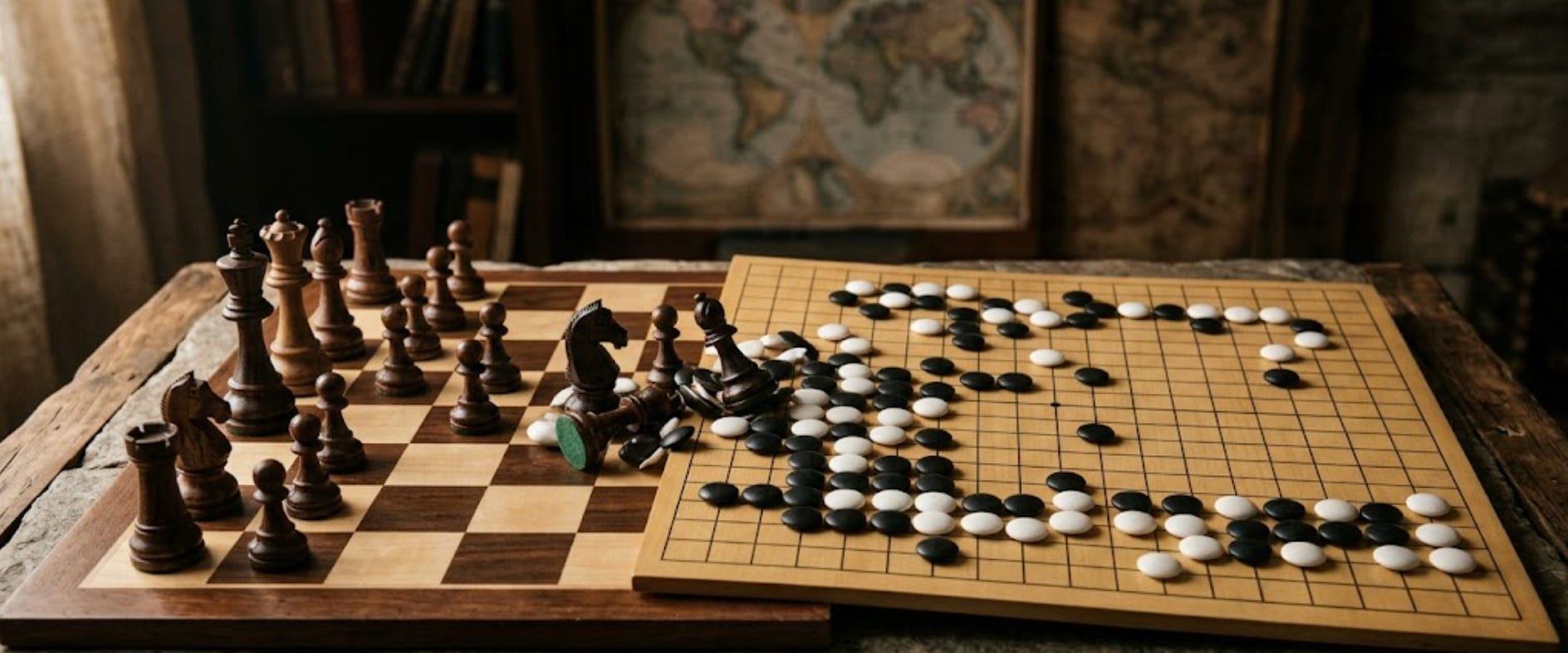
Those warnings have barely landed, because China operates in the shadows, in a way that looks so benign to the casual observer that much of the West has drifted into a vaguely favourable view of it. The second Trump administration helped a lot - an aggressive foreign policy of threats (military ones included, see: Greenland) and insults hurled at America’s own allies, which by sheer contrast made Beijing look… reasonable.
During my travels in East Asia, I was told that people there carry complex emotions that are hard to read from the face alone. I am blessed - or cursed - with the opposite condition: I have subtitles running across my face at all times, which makes masking my true feelings, or lying, a near-impossible task. (One of several reasons I never went into politics, despite the efforts of people who thought I should.) There is no better metaphor for China than that contrast. There is the mask: reason, pragmatic calculation, someone you could maybe do business with. And then there is what sits behind it - an entirely different beast.
Understanding China
"A special feature of Chinese civilisation is that it seems to have no beginning. It appears in history less as a conventional nation-state than a permanent natural phenomenon." - Henry Kissinger
It is wrong to think of China as a very large country. A bigger France, of sorts. Or a more populous Germany with worse human rights and more factories. It isn’t. And until you internalise that, every prediction you make about Chinese behaviour will be wrong in the same direction - it will be too optimistic, and viewed from the perspective of a citizen shaped by the Western civilisation.
Let’s first clarify what Western civilisation means by identifying its’ pillars:
Athenian logic: categories, clarity, the open contradiction you argue out loud.
Roman law: institutions that outlive the men who run them.
Christianity: a soul that precedes the state, so the individual is sovereign and the truth gets arbitrated in a courtroom.
Clausewitz war doctrine: war as politics by other means - confrontation, decisive battle, the clash that settles it.
Out of that stew you get a rules-based order. Messy, argumentative, constantly renegotiated - but agile, capable of correcting itself, and above all - productive to the point of bringing prosperity across the world (not just the Western one).
China runs on completely different software, and far, far older one. As Henry Kissinger put it: China appears in history less as a conventional nation-state, but as a civilisation that seems to have no beginning.
China is not a nation-state, in the European sense of the word, but a civilisation-state. Its founding imperative isn’t liberty, but the avoidance of chaos. Allow me to quote Kissinger again:
"Chinese thinkers developed strategic thought that placed a premium on victory through psychological advantage and preached the avoidance of direct conflict."
Why? Because dynastic collapse, civil wars that ran for generations, and mass death on a scale Europe didn’t taste until the Napoleonic wars are written into every chapter of Chinese history since 500 BC.
There are two ancient concepts worth learning when it comes to China.
Tianxia (天下)
It translates as “All Under Heaven”, but means one world, one centre, and at that centre - China. Beyond it are not equal civilisations, parallel histories, nor rival visions of order, but outer rings of incompletion: tributaries, barbarians, peoples not yet brought into the proper shape of things. In this framework, China is not one civilisation among many, but civilisation itself - the axis around which legitimacy, hierarchy, and history are meant to turn.
Everyone else exists at a distance from that centre. Some are to be managed, some instructed, some absorbed and Sinified, some waited out. The timescale hardly matters - tomorrow, a century, a thousand years from now: the logic remains the same. The world is disorder only until it is arranged around the centre, and that centre is China.
Guanxi (关系)
Another important term to understand the Chinese modus operandi: guanxi. It is usually translated blandly as “connections,” but that misses the point. Guanxi is not networking in the Western, LinkedIn sense. It is a dense web of obligation, favour, debt, access, and memory - the informal architecture beneath the formal one.
In a Western system, at least in theory, you reach for the visible mechanisms: institutions, law, courts, procedure, appeal, protest, publicity. In China, the instinct is different. You call the right person, you activate a relationship, remind someone of an old favour, or incur a new one. Guanxi network. I once had a Chinese VP, and when he started interviewing for expanding the team - he only ever interviewed East Asians from his own Guanxi network. That, of course, is not the most illustrative example of guanxi, but it was the closest one I have seen in real life.
Clausewitz vs Sun Tzu
The military doctrine that runs China is also diametrically different from the one running the Western war machine - it is Clausewitzian, at least not in the Western sense of war as a concentrated test of force, will, and decision. It is Sun Tzuian: victory as something prepared long before the battlefield unfolds (if ever).
Deception over declaration. Patience over escalation. Encirclement over impact.
The goal is not to meet the enemy at full strength and defeat him, but to make his strength irrelevant: to confuse his judgment, exhaust his options, divide his allies, and arrange the board so that by the time open confrontation becomes possible, it is no longer necessary.
Now stack the difference and re-examine your understanding of the Far East - we are not the same. The West talks about rights - each of us an individual with dignity. China talks about obligations - each person is a node in a nested hierarchies of family, clan, party, with duties running up and down the chain. That single inversion reorganises everything downstream: law, loyalty, leadership, freedom.
It also reorganises how you build a coalition. “Alliance” is a Western vocabulary. The West builds NATO, the EU, voluntary clubs of shared interest between formal equals who can, in theory, walk out. China doesn’t build alliances, it builds dependencies. Everything bilateral, transactional, and hierarchical. If you are smaller, you are a subordinate - that isn’t an insult, it’s just the org chart of China Inc. This is the part people who cheer for “multipolarity” never think through: the ideal world in China’s imagine is not multipolar, but monocivilizational, on Chinese terms, with one pole and a lot of tributaries who haven’t been told yet. I’ve said this since I was a freshman in college - if you don’t like the Western world order, I can guarantee you, you’d hate the Chinese one more.
The Russo-Ukrainian connection
I think at that point, it is self-evident: russia would never have launched the full-scale invasion without Beijing’s blessing. Putin went to the Olympics in February 2022, signed the “no limits” partnership, and the tanks rolled days after the closing ceremony. Treating that as a coincidence is being wilfully blind to what is, in fact, a sequence.
For a long time China played “neutral”, and to the casual observer it was. Beijing’s foreign ministry says, on a loop, that China is “not a party” to the war. Then, occasionally, the mask slips. In July 2025, Foreign Minister Wang Yi sat across from the EU’s Kaja Kallas and told her, in private, that Beijing could not accept a russian defeat in Ukraine - because a russian loss would let Washington swing its full weight onto the Indo-Pacific. EU officials were reportedly startled by the frankness (as tradition dictates, EU officials will be the last to figure out there is a fire burning down the roof over their heads). They shouldn’t have been. Wang is the regime’s most seasoned diplomat; he doesn’t misspeak in a four-hour meeting.
In the same breath he denied that China was arming or financing the war, and added the line that gives the whole game away: if China were really helping, the war would already be over.
Read that the way it was meant. We are helping russia enough to keep it fighting, and not one inch more than that. We could end this tomorrow if it served us. It doesn’t.
And why would Beijing want the dial there? Because a russia that is bleeding but not broken is the perfect instrument. It pins the United States and Europe in the wrong theatre, burns Western stockpiles and Western money, and buys China time to keep treating the South China Sea like a private lake and Taiwan like an overdue delivery. While Ukraine bleeds, Beijing positions itself to collect, because they have the luxury to think in dynasties, while we are confined to thinking in election cycles. It is not a fair fight of attention spans.
There’s another uncomfortable second-order effect: even a trillion euros of European rearmament is worth very little if you cannot source the materials to build the weapons. The CEO of AMG Lithium, Stefan Scherer, told the Guardian last summer that Europe may as well be a “province of China” given how dependent it is on imports. Europe has the money. It does not have the minerals, the processing capacity, or the industrial base to scale defence production on its own. Artillery shells, precision guidance, the magnets inside every actuator and seeker head, advanced semiconductors - the supply chains run back through China. And not just Europe’s. The Pentagon depends on China for a large share of the rare-earth inputs that go into the F-35 and its naval radars (among many others).
This did not happen by accident, and it did not happen overnight. China spent three decades deliberately making itself indispensable - in raw materials, rare earths, pharmaceuticals, electronics, the complex manufacturing nobody wanted to do at home. It bought the bottlenecks of globalisation, one by one, while we fell in love with cheap labour and short-term growth. Western firms handed over technology, swallowed forced joint ventures, and looked away from the IP theft, all for a seat at the China market. And along the way Beijing captured something more useful than any factory: it captured constituencies inside our own democracies - executives, universities, the occasional politician - who became a standing pro-engagement lobby, defending the relationship even as the knife turned.
So here we are. China is embedded in our supply chains, our capital markets, our infrastructure, our digital plumbing, and it is using a dependency it engineered on purpose to challenge, and eventually subordinate, the West. They have a name for the project. The Chinese Century.
All the wrong questions
So when people argue about whether China supports russia’s war on Ukraine, they are asking a question that was settled years ago. It does. The more interesting question is: how, at what scale, and what does Beijing get out of it?
Since 2022, China has become the substitute supplier for most of what sanctions were supposed to cut off - machine tools, microelectronics, optics, the dual-use inputs a defence-industrial base cannot run without. Not warheads, but components. Beijing stays a careful step back from the lethal-aid red line so it can keep saying, with a straight face, that it isn’t a party to the war. Plausible deniability. Which is exactly why the serious secondary sanctions should have landed early and hard, while the channels were still forming, yet - they didn’t.
At what scale, and with whom.
There’s a handy term - CRINK. It is an acronym coined by geopolitical analysts to refer to the loose, anti-Western coalition of China, Russia, Iran, and North Korea. This bloc increasingly cooperates to challenge U.S. and Western influence through shared economic ties, military alignment, and mutual support for undermining international sanctions.
It is not an alliance - remember, China doesn’t do alliances, that’s a Western vocabulary. What it is, essentially, is a division of labour. North Korea ships shells and bodies. Iran sent the drones and the know-how to build more. China supplies the industrial backbone and the financial plumbing underneath. Each one covers a gap the others can’t, and what binds them is not friendship but a shared adversary and complementary shortages. A division of labour organised around a common strategic interest.
What does Beijing actually get? Three things, and they compound.
First, a russia that is dependent, not merely friendly - the asymmetry in that relationship now runs entirely China’s way, and a vassal is worth more than a partner.
Second, a live, real-world laboratory for exactly how far Western sanctions can be circumvented, and how much of that trade can be pushed into yuan while you’re at it.
Third, a fragmented world that keeps American attention permanently scattered - and, as a bonus, a Global South that increasingly looks to Beijing for the security and prosperity that Washington seems too distracted to offer.
And the part most analysis walks straight past: the domestic signal. On the Chinese internet, the war gets framed - often in genuinely toxic, triumphalist terms - as a proxy fight the West is losing, and the official line has quietly converged with the popular mood rather than correcting it. When state narrative and street sentiment point the same way, a policy acquires a domestic constituency. And policy with a domestic constituency is far harder to reverse, because reversing it now costs the regime something at home.
Put all of that together and you arrive at the word in this article’s subtitle. Beijing has not made a series of opportunistic decisions about russia. It has built an architecture - durable, deniable, mutually reinforcing, and quietly profitable. And if you’ve understood that, you’ve understood why the standard Western policy reflex keeps failing. Sanctions are designed to raise the cost of an individual decision: make this transaction painful enough and the actor reconsiders. But with China, you are not facing an actor weighing a decision, you are facing a system engineered to absorb cost and pressure. You can sanction your way through a choice, you cannot sanction your way through a structure. The response has to target the architecture itself - and naming it as architecture is the first step to designing something that actually works.
The architecture, made visible
Look at what China did with rare earths in late 2025.
Chinese firms process roughly 90% of the world’s rare earths and make the overwhelming majority of the high-performance magnets that go inside missiles, jets, drones, EVs and wind turbines. That dominance was built over thirty years with state financing, predatory pricing, and export controls on the processing technology so nobody else could climb the ladder. Then, in October 2025, Beijing did something even more severe than the earlier embargo of circa 2015 - it announced a licensing regime modelled on America’s own extraterritorial export rules: any product made anywhere on earth that contains as little as 0.1% Chinese-origin rare earths, or was made using Chinese processing technology, now needs Beijing’s permission to ship. And it stated outright that it would not license rare earths for use by foreign militaries.
Think about it - we are talking about a licensing requirement that reaches inside a Western defence contractor’s supply chain and switches it off from Beijing. Ford had to idle a plant in Chicago because it couldn’t get the magnets for ordinary car parts. A US congressional committee called it a loaded gun pointed at the American economy. That is the mask off - and it is precisely the Sun Tzu logic from the top of this essay: not the decisive battle, but arranging the board until the battle is unnecessary because the other side simply cannot fight.
I’ve said it before, and I will keep hammering it until the day I die: Missiles. Don’t. Grow. On. Trees.
Death by a thousand cuts, is the true face of the Sun Tzuian war doctrine. And people - be it ordinary citizens or political decision-markers - don’t even know we are at war with China. A war that they started by weaponising the downstream they spent three decades taking over.
Selling the rope on which Russia will hang itself
Third time is a charm, so here’s your third reminder that China doesn’t do alliances. The natural conclusion would be that China is somehow saving russia - Beijing keeps the war economy supplied, buys the oil, ships the components, so it must be the lifeline keeping the russia afloat.
Yes. And no.
Let’s look at what China is actually doing to the russian economy. Chinese goods have flooded the russian market since 2022 - better made, cheaper, and russian firms cannot compete with them even when Moscow stacks protective tariffs on top (Western industry knows this pattern too well). Look at cars: when Western brands walked out, Chinese manufacturers swallowed the market whole, and the Kremlin has been hiking import fees ever since to keep what’s left of its own auto industry breathing.
Another example - the gasoline everyone points to. Yes, China ships fuel to a russia whose refineries Ukrainian drones have been methodically setting on fire. But imported fuel lands far more expensive than what russia would have refined for itself - so every litre is both a higher cost and a slice of refining profit russia is no longer earning, in the exact window when world energy prices would have made that profit fattest.
And notice what China has sold vs not sold. It is selling components, dual-use parts., optics, chips, machine tools - the same category of goods China sells half the planet, not so different from what reaches Ukraine through its own channels. What it hasn’t sold to russia though: advanced combat drones, modern armour, air-to-air missiles, serious air-defence systems. Beijing could turn this war in russia’s favour by simply flooding it with weapons, but it hasn’t because provoking the West isn’t worth it to China, and because Beijing privately regards the invasion as the strategic blunder it plainly was. China will feed the war to continue, but it will not win it on Moscow’s behalf. That is the dial Wang Yi was describing in his meeting with EU officials.
Then there’s my favourite illustration, because it is almost too on-the-nose. russia’s only optical-fibre plant - the feedstock for the fibre-guided drones doing so much of the killing - sat in Saransk, until Ukrainian strikes knocked it offline in 2025. With Western suppliers already sanctioned away, that left russia completely dependent on China for optical fibre. And the moment russia had nowhere else to turn, the price for russian buyers specifically jumped two-and-a-half to four times over. A global, AI-driven fibre shortage is part of the story, sure - but everyone is short of fibre, and it’s the russians who got handed the captive-customer markup.
Bottomline is that China isn’t running a charity for Moscow, but charging premium on russia’s desperation - hollowing out russian industry, fleecing it on the inputs it can no longer make at home, and binding it tighter with every transaction. WIth such allies, who needs enemies? China isn’t “saving russia”, it’s selling the rope with which russia will hang itself on the Red Square. The added bonus is that the West will be exhausted too at the end of all this - exhausted in resources, funds, weapons, etc.
That is Sun Tzu.
The Balkan candor
A dear friend once asked me whether all of this is exhausting - whether it wears me down to keep track and weighing every side. No. Here is what separates me from the people who masquerade “neutrality”: having looked at all sides, I have picked one.
I won’t sell you skewed or manipulated takes, not perform the bloodless impartiality that passes for seriousness in this field. I come from a post-communist country, and that leaves you with one non-negotiable value: liberty. Neither China nor russia can offer me that - self-evidently - so I stand with the side that won the first Cold War.
Yes, I take a side. I do it for free, beholden to no one but a few dozen gracious subscribers I am genuinely grateful for - no government behind me, no institution, no think-tank to pay my rent. What you see is what you get. Take it or leave it.
However, picking a side does not mean going soft on it. The Western world is my home, and yes - I think it superior to everything else on the menu, in every metric that actually matters to me. Which is precisely why I am merciless with it. I’ve hammered France for spending itself broke. I’ve hammered Germany, which you’d hope might avoid fumbling the 21st century given how thoroughly it fumbled the 20th - twice (my honest verdict on the Merkel years isn’t fit for polite Substack company). Brussels, Washington, all of them, constantly. Every day. Not because I want them to fail. Because I want them to do better - the same reason I am always hardest on the party I actually voted for. I gave them my vote, my trust. I didn’t give it to the other lot.
And I will not lie to you about how far our adversaries have pulled ahead, because pretending otherwise is intellectually dishonest. Ordinary citizens and the people making the decisions both need to feel that gap honestly, becsuse you cannot close a distance you refuse to measure.
What I want is simple. I want the pillars this essay began with - Athenian logic, Roman law, and yes Christian values (it’s irrelevant whether you or I am one: it’s about the individual being a soverign) - to survive, thrive, and prevail. I do not want to leave my children a world run from Beijing, with the rest of us filed under tributary or outright vassalage.
Churchill called democracy the worst form of government, except for all the others. The Western rules-based order is the same: slow, flawed, maddening - and the worst system going, except for every other dish on the menu. China is offering you the polished alternative right now, mask on, reason in its voice. So here is the question: when the choice finally comes, will you have the nerve to defend the flawed thing you have (and improve it) - or will you mistake the fake mask for an upgrade?
Nice one.
I’ve chosen my side. Democracy is messy, frustrating, and imperfect, but it’s still worth defending. I’m tired of people pretending that all systems are the same or longing for “strong leaders” with easy answers to difficult problems. Freedom and democracy are worth standing up for.
"Rather than risk direct warfare the Chinese developed economic strategies to control their foreign enemies.
[...]
Under the Emperor Ching (157-141 BC) the Han regime founded a series of large border markets near well-guarded gateways in the Great Wall. 52 A Chinese study called the Hsin Shu explains the operation of this policy which was designed to make the Xiongnu economically dependent on Chinese products.
[...]
Once this economic dependency was established then the Chinese could exert political pressure on the Xiongnu by threatening to withhold or limit their access to Han products. The Hsin Shu explains, 'if the Xiongnu kings and generals try to lead their people away, they will be defied by their followers. When the Xiongnu have developed a craving for our rice, stew, barbeques, and wine, they will have a fatal weakness.
[...]
The Discourse on Salt and Iron explains that 'a piece of plain Chinese silk can be exchanged with the Xiongnu for articles worth several pieces of gold and we can thereby reduce the resources of our enemy.' Silk was a renewable product for the Chinese economy and therefore 'new goods are received while the government retains abundant supplies. National wealth is not being dispersed into foreign countries and the people enjoy abundance."
From "The Roman Empire and the Silk Routes: The Ancient World Economy & the Empires of Parthia, Central Asia & Han China" (Chapter 3)