
Manufacturing Discord: A Decade in Review
A decade of culture, race, and gender wars trained us to do our enemies' work for free.

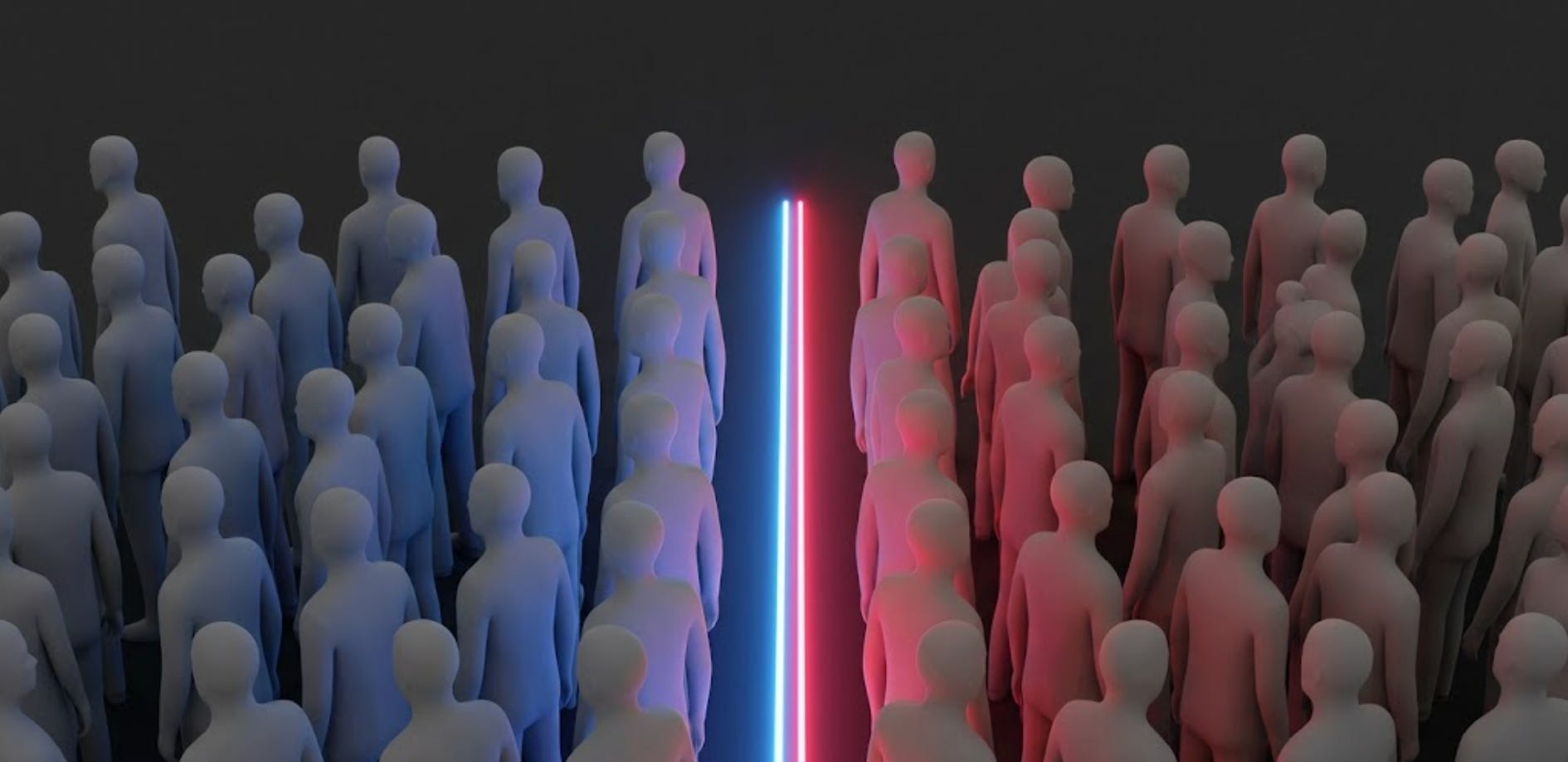
Before I do a deep dive on this topic, let me first tell you where I am standing, because it determines what I can see.
By virtue of my geography of birth, I carry no colonial guilt, because there was no empire to inherit - only the long experience of being the terrain other empires fought over. I have no white guilt to perform, no imperial past to atone for, no civilisational debt anyone has convinced me I owe. (When Bulgaria wrote its first constitution in 1879, the moment we crawled out from under five centuries of Ottoman rule, its’ authors put in a clause declaring that any slave - of any gender or creed - became free the instant he set foot on Bulgarian soil, so look elsewhere for guilt when it comes to slavery, you won’t find one here).
That vantage point matters, because the thing I am about to describe is almost impossible to see clearly from inside it. The people who lived through the last decade in London, Portland, Paris, or Toronto are standing too close to the fire. They feel its heat as their own. They have a tribe, a side, a set of sins they are required to confess and another set they are required to denounce. I have none of that. I am, and have always been, equally disliked by both camps (remind me to put that on my LinkedIn under skills set!).
A decade of culture wars, race wars, and gender wars - what they were really made of, how they radicalised each other in a feedback loop almost nobody named while it was happening, and how foreign states learned to pour accelerant on a fire we had very kindly built ourselves. I am going to be unkind to the left and unkind to the right in roughly equal measure, because the truth is unkind to both and I refuse to flatter either to win a tribe I don’t want.
The Human Weak Link
There is a comforting story we tell ourselves, the one that runs underneath nearly every well-meaning institution in the modern West: give people the facts, educate them, connect them, and they will converge. Truth and reason will win. We are, at bottom, rational creatures who disagree only because we are insufficiently informed.
It is such a beautiful idea, too bad it is also wrong.
In the 1970s, a Polish social psychologist named Henri Tajfel - a man who had survived the war in a French POW camp while most of his family was murdered in the Holocaust - set out to answer a question that had become, for him, deeply personal. How does one group of human beings come to hate another so completely that it will commit genocide against it? The prevailing assumption among his peers was that such hatred required something substantial: a real conflict over resources, or aggressive personalities clawing their way to power and inciting the mob.
Tajfel was sceptical. He looked across centuries of conflict and noticed that the supposed sources of all this world-ending hatred were, on inspection, remarkably thin - arbitrary, often trivial differences elevated into existential ones. So he ran an experiment that has since become foundational, and faintly terrifying. He divided strangers into groups on the basis of nothing - a coin toss, a preference between two painters, distinctions with no meaning whatsoever. And then he watched as people, knowing the groups were arbitrary, knowing the other side was identical to them in every way that mattered, immediately began favouring their own and discriminating against the others.
This is the minimal group paradigm, and the conclusion it forces is this: it takes almost nothing to make human beings form a tribe, and the moment they do, they start treating others as lesser. Not because of grievance. Not because of resources. Because of the line itself. We do not need a reason to divide. We divide, and then we manufacture the reason.
Modern neuroscience has only sharpened the blade. Our sense of self is so thoroughly braided into group loyalty that thinking in us-versus-them appears to be a structural property of the human brain rather than a bug we might debug with enough education. We will form a tribe around anything: religion, ethnicity, ideology - yes - but also football clubs, phone operating systems, dietary choices, the correct way to load a dishwasher. There is no quality so trivial that two camps will not form around it, and once they do, the favouritism, the signalling, and the contempt arrive on schedule, uninvited.
Which means the oldest military doctrine in the book - divide and conquer - has always rested on a flattering misreading. The conqueror does not really divide us. We were pre-divided. He merely finds the seam and pulls. We do the dividing willingly, often joyfully, and then thank the algorithm for the company.
The part the rationalists never want to hear - we are not built to pursue accuracy, not even truth. We are built to pursue belonging. Human beings are motivated reasoners - our interpretation of the facts bends, reliably and invisibly, toward what our group already believes and what our goals already require. The facts are not the input that determines the tribe. The tribe is the input that determines which facts we’ll accept.
This is why the great Enlightenment bets keep half-failing. It was naive when 19th-century rationalists believed public education would dissolve superstition and deliver an enlightened democracy. It was naive when Benjamin Franklin imagined that public libraries would close the gap between the common man and the aristocrat. It was naive when the cypherpunks of the early internet age were certain that giving everyone a printing press and an unmediated connection to all human knowledge would liberate us from gatekeepers and lies.
None of these were bad ideas. They built a vastly better world; I am typing this on the back of all three. But each rested on the same flawed premise - that the obstacle was a deficit of information rather than a surplus of belonging - and so each was, in the end, outflanked by the oldest thing in us. Give a motivated reasoner a printing press and he will not print the truth, he will print his tribe’s flag.
The last decade is the story of what happens when you hand exactly that printing press to a species that divides for sport.
The Autopsy, Part One: The Woke Left
I want to do this properly, which means I am going to say things that will get me called names by people who have not read past this sentence. Fine. Read past it.
Every movement I am about to dissect began with a real grievance. This is not a caveat I am adding to seem balanced to you; it is the load-bearing wall of the entire argument: the grievances were real. Racism, sexism, police brutality, homophobia, etc. are real. The climate is, in fact, changing.
What I am dissecting is not the grievance. It is what was done to it.
Because something happens to a legitimate grievance when it collides with the incentives of social media, institutional capture, and the human appetite for moral status. It gets commercialised, and it eventually - inevitably - gets infiltrated. And then, with frightening speed, it gets weaponised - turned from a demand for justice into a loyalty test, an instrument for sorting the pure from the impure, and eventually a weapon pointed at anyone within reach, including the people it was meant to protect.
Here’s how the mechanism works: a movement forms around an injustice almost everyone, asked privately, would concede is real. But a movement needs energy, and on the modern internet energy comes from one source above all others: moral outrage. So the boundary of acceptable opinion begins to move - not toward the centre, where persuasion lives, but ever outward toward the extreme, because the extreme is where the engagement is. Yesterday’s consensus becomes today’s bigotry. The reasonable person who agreed with the movement’s founding claim discovers, often overnight, that the founding claim is no longer enough. Now there is a vocabulary to enforce, a set of pronouns to perform, a list of words that were neutral last Tuesday and are career-ending today. The test is never passed. It is only ever failed, more and more easily, by more and more people.
And the punishment for failing it became genuinely frightening - out of all proportion to anything resembling justice. People had their lives dismantled over a single clumsy sentence. Old social media posts were exhumed and read in the worst possible light; a laughing react to a tasteless joke from fifteen years earlier could cost you your job in the present. The mechanism did not distinguish between a bigot and a person who had simply existed in a less censorious decade. It did not need to. The point was never really the offender, but the demonstration - the ritual public sacrifice that reminded everyone watching exactly how thin the ice was.
I watched what this did to ordinary people, and I will not pretend I didn’t. I watched normal, decent colleagues - people carrying no hatred, no discriminatory views, nothing in their hearts but the wish to be left alone to do their work - become quietly, constantly afraid of being perceived as insufficiently progressive in front of the wrong person, on the wrong day, and finding themselves on the wrong side of an HR process that had been handed the power of a tribunal and the temperament of a mob. They self-censored. They learned the new vocabulary and performed a piety they did not feel, because the alternative was professional death. You cannot build a healthy society on a foundation of people privately terrified of their own colleagues, and yet that is precisely what we built, and called it justice.
I will get personal, because I was inside this one too. As a woman in a professional field, I was never able to love the “women in [insert field here]” machinery the way I was supposed to. Not because I doubted that women belonged - I am one, I did, I do - but because of what the machinery did to my own head. I carry the ordinary imposter syndrome a lot of competent women carry, and into that pre-existing wound the DEI climate poured a question I could never fully silence: was I hired based on merit, or to fill a quota and decorate someone’s diversity report? That question is poison. It corrodes the confidence of the very women it claims to elevate, and it hands every resentful man in the building a ready-made excuse to discount them. If you live inside the progressive echo chamber, this complaint may sound bizarre, even ungrateful. Step one inch outside it and it is the most natural thing in the world. A policy designed to affirm women managed, for some of us, to install a permanent asterisk next to our own names.
This is the tragedy of the left, and I use tragedy in the precise, classical sense: an otherwise noble intention was destroyed by its own internal logic. The movements did not stay where they started. Confronted with the choice between consolidating their real and substantial gains - normalising, declaring victory, lowering the temperature - and escalating toward ever-purer radicalism, they chose escalation, because escalation is what the incentive structure pays for. And every escalation did something its architects never intended.
It built the woke right.
The Autopsy, Part Two: The Woke Right
If you want the cleanest illustration of horseshoe theory ever produced - the idea that the far left and far right, travelling in opposite directions, eventually meet at the back of the horseshoe - you just need to have been online for the last five years.
Because the right looked at the politics of grievance, of identity, of permanent victimhood and ritual denunciation, and it did not reject the method, it copied it. The woke right is the woke left in a different uniform, running the identical software on different hardware, and it is every bit as corrosive - which is exactly why a serious person has to indict it with the same vigour, or admit they were never serious.
Watch them reach for the same tools. Where the left curated crime and injustice statistics to prove perpetual racism and oppression, the right learned to curate them right back with their own narrative angle. Same statistical cherry-picking, same emotional payload of total grievance, opposite target. Where the left built an architecture of language enforcement and excommunication, the right built its own - its own list of unsayable things, its own heretics, its own ritual of digging up a person’s past to destroy their present. The cancel culture each side claims to despise is simply the cancel culture of the other side; their own they call accountability.
And the pendulum, having been shoved so violently in one direction, swung back with proportional fury. Out of the backlash against third-wave feminism and the “women in everything” decade emerged an entire economy of manosphere podcasters - men who discovered that misogyny, packaged as hard truth and sold to lonely young men, was one of the most reliable engagement products ever invented. They did not have to be right. They had to be aggrieved, confident, and loud, and the algorithm did the rest. The grievance underneath them was, again, partly real - young men genuinely are adrift and have been told that their problems don’t matter. But the movement that formed around that real pain did to it exactly what the left did to its pain: inflated it, monetised it, and aimed it at the nearest available enemy, which in this case was women.
It is no longer a fringe phenomenon, and I refuse to file it under fringe. When the chief executive of one of the most powerful companies on earth feels free to say it out loud, the Overton window has already moved. Alex Karp, the head of Palantir, told in an interview that artificial intelligence would erode the economic and political influence of “highly educated, often female voters” - whom he pointedly tagged as largely Democratic - while elevating “vocationally trained, working-class, often male” workers, and that anyone who didn’t grasp this belonged in an “insane asylum.” It is a powerful man narrating, with visible relish, a coming transfer of power away from a demographic he has coded as female, educated, and politically opposed to him.
And run alongside it the now-fashionable claim that women’s entry into the workforce is a prime culprit behind collapsing birth rates - as if the solution to a demographic problem were to quietly usher half the population back out of public and economic life. The honest version of this conversation - that many modern societies have made having children genuinely difficult and that this deserves serious conversation - gets steamrolled by the weaponised version, which is just an old resentment in a new suit. (And for what it’s worth, the underlying economics Karp suggested when he said men contribute twice as much to GDP is even lazier: women cluster in professions with less monetary impact, but more social one - teaching, nursing, healthcare, social work, etc. We can’t all be finance bros off optimising our fourth exit. Not everyone can be a serial entrepreneur, and a civilisation that only valued the ones who were would not last a generation.)
So: misogyny rebranded as realism. Selective statistics rebranded as forbidden truth. Excommunication rebranded as accountability. A politics of pure grievance and pure victimhood, identical in structure to the one it claims to oppose, distinguishable only by the colour of the flag and the identity of the designated villain. The woke right did not defeat the woke left, it became it. They are the two ends of the same horseshoe, leaning across the gap, and the thing they have most in common is that both of them are making the rest of us live inside their fight.
A Decade, in Order
Pull back and the shape of the thing resolves into a feedback loop, and feedback loops have a direction. Roughly, here is the decade.
The opening (mid-2010s). A cluster of genuine reckonings - over race, over policing, over the treatment of women, over who gets to be visible - collides with two new accelerants: a social media architecture optimised for outrage, and a generation of institutions eager to demonstrate their virtue. The grievances are real, the energy is real. The escalation begins, because the platforms pay for escalation.
The capture (late 2010s). The movements move from the street into the institution - the university, the newsroom, the HR department, the corporate brand. The vocabulary hardens into a loyalty test. The punishment for failing it grows wildly disproportionate. Self-censorship becomes a survival skill. A large, silent population of people who agreed with the original grievance begins to feel hunted by the movement that grew out of it. They do not become bigots, but they become available - a vast reservoir of quiet resentment, waiting for someone to speak to it.
The backlash (early 2020s). Someone does. The right discovers that the abandoned reservoir is the greatest political resource of the era, and it speaks to it in the only grammar the age rewards: grievance, identity, and outrage - the left’s own grammar, turned around. The manosphere monetises the loneliness. The populists monetise the immigration anxiety that respectable politics refused to touch. Each provocation from one side becomes recruitment material for the other, and hence - the horseshoe closes.
The detonation (now). The loop, having run for a decade, doesn’t stay online. It walks out into the street.
Belfast, or: I Told You So, and I Take No Pleasure In It
About ten years ago, I made an argument to the liberals I knew who held actual power, and I made it as plainly as I am making this. I told them: extend a hand to your opponents on the right. Sit down with the people raising concerns about immigration - specifically about large, poorly vetted inflows of young men from regions where women are treated as second-class and tribal violence is ordinary - and treat those concerns as legitimate, because they are. Have the honest, uncomfortable conversation now, while it is still a conversation.
Because if you don’t, I warned, you will not make the worry disappear. You will simply hand it to people far worse than the ordinary citizens currently raising it, and one day you will be dealing with actual Nazis - not the imaginary ones you’ve been calling everyone who asks an inconvenient question.
They did not extend the hand, in fact - they did the opposite. The concern itself was ruled illegitimate. To raise it was to reveal yourself as a racist, a fascist, a Nazi - the words deployed not as descriptions but as off-switches, ways to end a conversation that should have been the beginning of one. The possibility that ordinary people might have ordinary, rational reasons to worry was waved away as false consciousness. And into that vacated, unguarded space - because grievance, like nature, abhors a vacuum - walked exactly the people I had warned about.
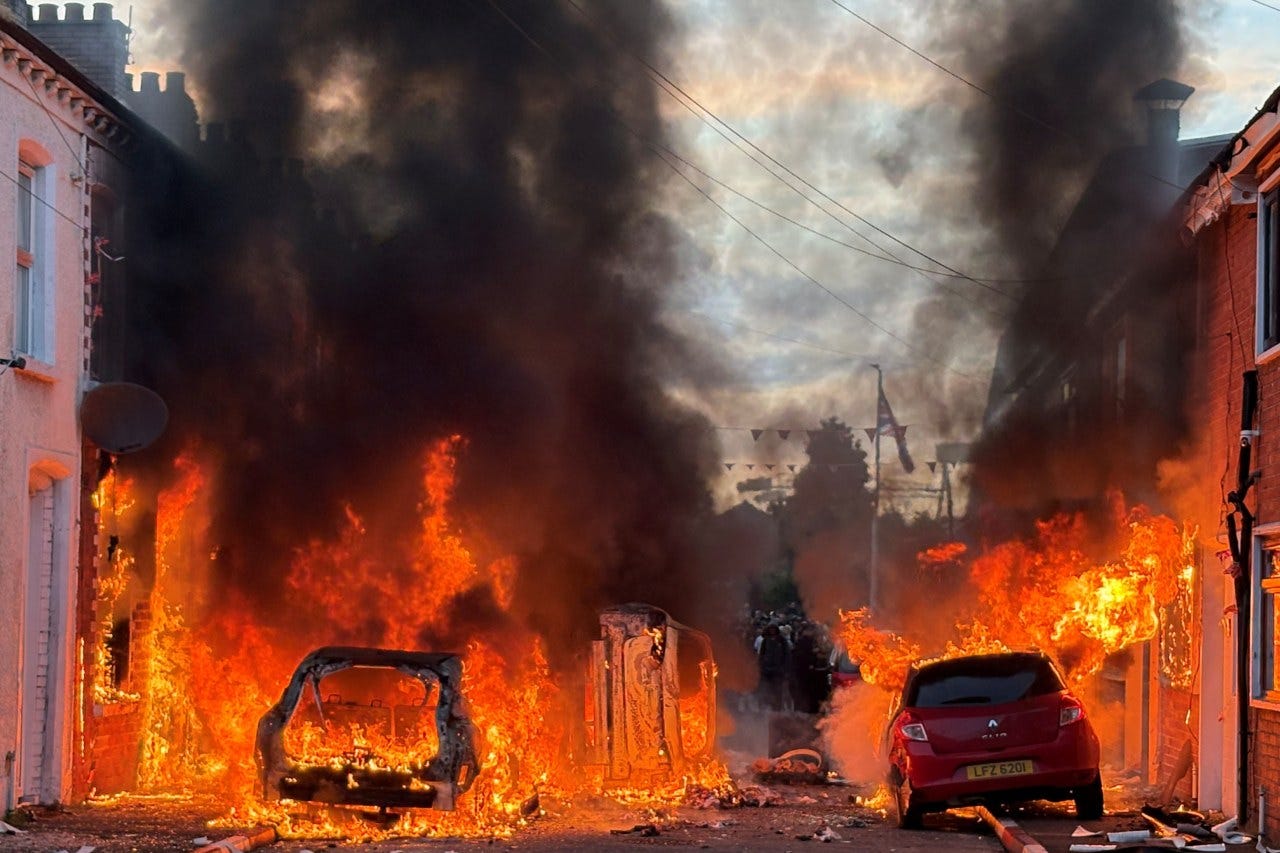
This week, in Belfast, the bill came due.
A Sudanese man attacked a local and attempted a beheading, halted by bystanders, one of whom fought him off with a hurley. The video - a truly gruesome video - circulated within hours, and it was genuinely horrific; I will not pretend otherwise, and neither should you, because pretending the horror isn’t real is precisely the comfortable-class move that got us here.
What followed was everything the decade had been priming. Riots across Belfast. Masked men kicking in doors on the Lower Newtownards Road, announcing they were “getting the foreigners out.” Homes torched, a Middle Eastern supermarket burned, a Turkish barber shop attacked - Turkish, note, being neither Sudanese nor anything in particular except foreign enough. Some of it was real, combustible, comprehensible anger. Some of it was a coordinated pogrom. Both things are true, and any account that admits only one of them is propaganda.
Two people from the wreckage tell you everything. A local Irishman, interviewed after losing his home to the fires, said he understood the rage - felt it himself - but that burning people’s houses solves nothing. He was right, and he now holds his correct opinion without a roof over it. And a Ukrainian refugee, a young woman who has clearly lived in Northern Ireland for years because the Irish lilt has crept all the way into her accent, whose home also burned - a woman who fled drones over Kyiv only to be set alight in Belfast. I made the mistake of reading the replies under her interview, and within thirty seconds I knew the bot farms were earning their wage: crude sexual remarks, accounts insisting half of Ukraine is perfectly safe so she should go home, that the clubs in Kyiv run all night so what’s her excuse. And the tell - every last one of them wrote Kiev, not Kyiv. The occupier’s spelling.
The fire is real. The size of it is a special effect. There is a genuine problem with parts of European migration - importing large numbers of young men from cultures that are incompatible with Western liberal values, premised on the legal equality of men and women, creates real and predictable friction, and the people living next to that friction have every right to name it. That grievance is legitimate. It was legitimate ten years ago, when naming it got you branded a Nazi. And it is exactly because it was dismissed for so long that it has now been inflated, by domestic opportunists and foreign states alike, from a real and solvable problem into something that feels like civilisation collapsing - and discharged as a pogrom that left an Irishman and a Ukrainian refugee homeless on the same burning street. Which tells you, if you think about it for one honest second, precisely how much this movement actually protects the people it claims to be defending.
I take no pleasure in “I told you so.” And unless something changes, Belfast is not the end of this, but the beginning.
While Belfast burned, the most recognisable face of British street nationalism (namely, Tommy Robinson) - the man whose name was on the protest calls - was not in Britain. He was in Moscow, in the bar of a five-star hotel a few hundred metres from the Kremlin, filming himself with Elon Musk’s Putin-admiring father, promising his followers they were going to “cause some trouble,” and announcing that Russia “is not the enemy of Britain.” From that bar stool he helped summon a night of riots in the United Kingdom. I do not know, and it does not matter, whether he is an agent, an asset, or merely a useful idiot. The taxonomy is a distraction. What matters is that the architecture is now visible to the naked eye - and that brings me to the part of this story that the culture warriors on both sides least want to discuss.
The Jackal’s Patience: When State Actors Light the Fire
Here is the oldest trick in the book of statecraft, and both of the great authoritarian powers of our age have built a doctrine around it: you do not need to defeat your enemy if you can get your enemy’s neighbours to do it for you. You sow resentment between peoples who should be allies. You deepen every existing crack. You flood the zone with lies until no one can agree on what is even happening - and then, once the neighbours have exhausted and bloodied each other, you walk in and take the spoils. The jackal does not make the kill. The jackal waits for the lions to wound each other, and then strolls over to feed.
Russia and China both understand that they cannot win a conventional war against the West - so both have invested, enormously, in winning without firing a shot. This is not me engaging in speculation; it is documented to the point of tedium. Russia has been caught, repeatedly and in detail, weaponising the very dynamics this essay has described. It has weaponised migration as a literal instrument of statecraft, pushing people toward European borders to overload the systems and inflame the politics. It has learned to fuel the fringes of both sides of any given conflict at once - running, in one well-documented case, a network of fake news sites posing as far-right outlets and a parallel network posing as far-left ones, because the goal was never to win an argument. The goal was to make the argument unwinnable.
And it has become expert at weaponising history itself. Look at Poland and Ukraine - two nations that have suffered more under Russian domination than almost anyone, and who therefore ought to be allies. Yet every six to twelve months a new diplomatic wound opens between them, frequently around the 1943 Volhynia massacres. The grievance is real and the dead are real. But the timing of its periodic resurfacing is not random, and Russian information operations have been documented amplifying it relentlessly - pushing fabricated stories to convert a manageable historical sorrow into a live political rupture between two allies Moscow desperately needs to keep apart. The economic version runs in parallel: when grain disputes set Polish farmers blockading the border in 2024, delaying military aid bound for the Ukrainian front, Russian accounts were there in the comments, pouring fuel, because a tractor blocking a road full of night-vision gear is worth a great deal to a man in the Kremlin.
The operation has gone global and industrial. Russian troll farms famously ran out of office buildings in Ghana and Nigeria, staffed by locals hired to impersonate angry Western citizens - and the model has only expanded, with Russian state media building out African bureaus and bot networks precisely as Western outlets retreat from the continent for lack of funds.
And then there is the purest illustration of all, the one I keep returning to because it requires no Russian operative whatsoever. In June 2025, around 150 pro-Palestinian activists stormed a Belgian factory, OIP Land Systems in Tournai, smashing equipment with hammers and grinders to “stop arming Israel.” There was only one problem: the factory armed nobody in Israel. It refurbished armoured vehicles for Ukraine - and the raid delayed deliveries to the front by at least a month and inflicted around a million euros of damage. The activists may have believed that they were striking a blow for Gaza. What they actually did was hand Vladimir Putin a month of advantage, for free, with their own hands. Nobody directed this. That is the whole, terrible point. You do not need a handler when outrage, unmoored from facts, reliably produces the outcome the adversary wants. The match-lighter and the accelerant merchant never had to meet. The architecture introduces them.
Now - because I promised to be unkind in both directions, and because a one-sided indictment of foreign powers is just another tribe’s propaganda - let me say the obvious thing the West would prefer I didn’t. This trick is not Russian or Chinese property. It is a tool, and the West used it too. The British did not build the largest empire in history through superior numbers; they built it largely through divide and rule - finding the seam between communities, castes, and princes, and pulling, so that subject populations spent their fury on each other rather than on the colonial administrator collecting the revenue. The Opium Wars were that same cold logic in economic form: a great power forcing open another society’s markets, addiction and all, because the trade balance demanded it. The technique is human, not national. What has changed is not the strategy, but the delivery system - and the delivery system is now in everyone’s pocket, running all day, billing us in attention.
Why You Have to Hold Both Truths at Once
I have spent this essay insisting on a position that satisfies nobody: the grievances are real and they are being inflated; the movements began in justice and curdled into something ugly; the foreign hand is real and it is not the whole story; people are angry for genuine reasons and are being played. Every one of these sentences has an “and” where most people demand an “or.” I am not trying to engage in fence-sitting, it is just the only factually accurate place to stand, and it is lonely precisely because it is genuine.
Here is the trap most analysts fall into, and especially the academics, who ought to know better. They inject their own tribe’s bias without ever noticing they’ve done it - because motivated reasoning, remember, is invisible from the inside. The liberal analyst sees the right’s manufactured outrage with perfect clarity and goes conveniently blind to his own side’s excesses, or minimises them, or contextualises them into harmlessness. The conservative analyst does the identical thing in the mirror: razor-sharp on the left’s authoritarian streak, utterly unable to see his own side is engaging in similar discourse. Each produces work that is half-true, which is more dangerous than work that is simply false, because half-truth flatters its tribe and travels further for it.
I don’t have that problem, and I will be honest about why - it is not virtue. It is that I have no tribe to protect. I have always been disliked by both camps, and I will not pretend the early years of that weren’t hard, even lonely, because the human animal wants a tribe the way it wants food and warmth; Tajfel proved we will invent one out of a coin toss rather than go without. Standing in the gap, refusing the flag both sides keep trying to hand you, costs something real. But it is the only vantage point from which the whole machine is visible at once - and the whole machine is the only thing worth describing.
Which brings me back to where I started. If you cannot hold the left’s real sins and the right’s real sins in the same hand, at the same time, without one of them dissolving into “yes, but” - you are not analysing the decade. You are participating in it. You have a side, and your side has a set of facts it has agreed not to look at, and the people who pull the seams know exactly which facts those are. They are counting on it. They have built an entire architecture on the certainty that you would rather be loyal than be right.
Balkan Candor
In the Balkans we learned young that the surest way to control a population is not to lie to it about the facts - the facts can be checked. It is to lie to it about its neighbours. Convince people that the family down the road is the enemy, and you never have to govern them at all. They will be far too busy guarding the fence to notice who is quietly emptying the treasury.
The West is doing this to itself, and mostly for free. It took real wounds and instead of treating them, it sorted them into tribes and set the tribes on each other. The left refused to consolidate its victories and chose purity instead, and in doing so manufactured the very reaction it claimed to fear. The right caught the abandoned grievances and weaponised them with the left’s own tools, and called it freedom. And standing patiently at the edge of the firelight the whole time, neither lighting the first match nor needing to, were the state actors that profit when we are too busy hating our neighbours to notice the jackal at the treeline. Belfast is an illustration of the past decade, condensed into a single burning street, with an angry local and a refugee left equally homeless on it, while the man who called the mob raised a glass in a 5-star Moscow hotel.
The answer is not to pretend the problems away - a decade of dismissal did not extinguish the grievance but handed it to arsonists. The answer is to drag every one of these quarrels back from the people farming them and own them ourselves - to insist, against an architecture engineered for the opposite, that we can hold a real grievance in one hand and refuse the pogrom with the other.
A fabulous piece and a warning to all in the "enlightenment" WEST.
For one thing, DONT LET THE WRONG TRIBE IN.
For another, we have totally misinterpreted the original revolutionary premise of freedom FROM religion...AT OUR COST!
Brilliant. Insightful. Refreshing honesty. Thank you