

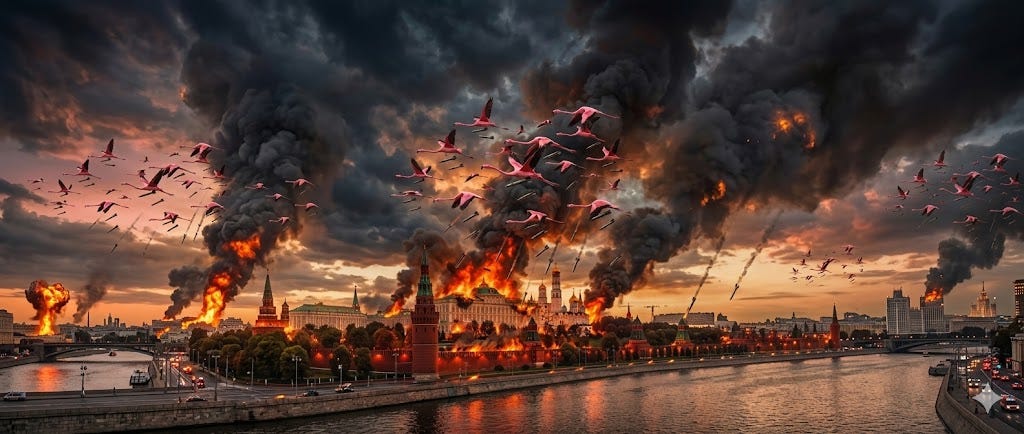
There’s a comfortable assumption floating around that fighting a bigger state - bigger in land, bigger in population, bigger in money - is a fight you’ve already lost. It sounds like common sense - the big battalions win, the bigger GDP wins, just do the math and go home. Yet history has been telling us this assumption is wrong for about 2,500 years.
This is the part everyone got wrong about Ukraine from day one: russia is too big, too powerful, it has bigger GDP, bigger population, second army in the world, etc. Ukraine is doomed, Kyiv falls in three days, the only question is how big the leftover rump will be.
Bigger never meant better
Finland, 1939: the Soviet Union - same empire, same Kremlin imperial mindset - rolled into a country of fewer than four million people expecting a stroll, and got its army butchered in the snow instead. Israel, 1948: a state declared on a Friday and invaded by the combined armies of its neighbours before the ink was dry, written off by every serious person as a corpse-in-waiting, that somehow refused to die. The Greeks did it to the largest empire on earth at Salamis. The Afghans did it to the Soviets across a decade that helped bring the whole rotten Union down, and eventually the Taliban that met the American army were the ones sending it home. Being big, rich and strong has never come with a guarantee of success attached. It just feels like it should.
Now - and yes - being small doesn’t guarantee you win either. Small countries get crushed constantly. The Baltics in 1940. Czechoslovakia in 1938. Georgia in 2008. Crimea in 2014, for that matter. The point isn’t that the underdog always wins. The point is that size is only one variable, and it stops mattering very fast when four things line up at once: the smaller side is defending its own home, the war drags into attrition instead of a quick knockout, somebody is backing the defender - and the thing that actually decides it turns out to be the aggressor’s economy and its will, not its order of battle.
It’s been twelve years. Yes - twelve. Count from the little green men in Crimea and the fuse lit in Donbas, not from 2022. Twelve years, a generation of men, and the entire credibility of the russian state poured into this thing. Which of russia’s war aims has actually been achieved?
Go down the list. One by one. The answer?
None of them.
The scorecard
Strategy is relationship between the aims you picked, the means you spent, and what you actually got - and the people cheering on either side of this war are usually the ones skipping that arithmetic. So let’s do it.
The puppet state objective.
The plan in 2022 was the Belarus model - collapse Kyiv, run Zelenskyy out, install some compliant Yanukovich-grade marionette and call it a win. It failed completely. The government didn’t fall. Kyiv didn’t capitulate. And here’s the part Western analysts keep underrating because they don’t feel it in their bones the way we do: a pro-russian president will not set foot in Kyiv again for a thousand years. Believe me - Eastern Europeans know how to hold a grudge. russia didn’t lose a battle for the capital. It permanently killed the political outcome the whole war was built to produce.
The erasure of Ukrainian identity objective.
Putin wrote the essay himself: Ukrainians aren’t real, the state’s an accident, time to undo it (in a nutshell, that’s what he said). The result ended up being the exact opposite of stated objective. I have watched Ukrainian identity go through a renaissance I genuinely never expected to see in my lifetime. Even the Russian-speaking easterners who used to shrug at Moscow out of proximity and mixed families have turned on it with the specific fury. At the end of the day, russia resurrected the very thing it set out to destroy - the Ukrainian state and its’ strong, rooted in centuries old history.
A conquest that conquered almost nothing.
In twelve years the only large city russia has taken and held is Mariupol - and it “took” Mariupol by grinding it into powder. Same with the smaller Donbas cities, Sievierodonetsk, Bakhmut, Avdiivka: erased, not captured, at a casualty rate that would have ended any war in a country where the public is actually civilised. The big regional capitals it actually wanted - Kharkiv, Dnipro, Zaporizhzhia, Odesa - are still Ukrainian. The one it did grab, Kherson, it then lost, in a humiliation Putin had personally promised would never happen. The 2026 spring offensive that was supposed to crack this trend has stalled. Ukraine has clawed back more than 600 square kilometres this year, and in May took back more than it gave up. The russian army spent three and a half years of crawling across villages at a snail’s pace, giving 30k dead bodies for a few sq.km. of an abandoned village. Does this look like a winning by the “world’s second best army”?
The weaponisation of energy.
Since russia cannot afford to have a competent army (otherwise it might organise a military coup and hang the arrogant KGB cabal that’s running the state), weaponising their energy exports was supposed to be the winning move - choke the gas, freeze the Germans, watch the sanctions coalition crack as voters revolt against cold houses. The Kremlin even produced the propaganda for the winter it was sure was coming: an RT Christmas ad where a freezing European family ends up cooking the kid’s pet hamster for dinner. It was meant as a threat, and it aged like milk. Europe took the blow and didn’t stop its’ support for Ukraine. Dependence on russian gas fell from 45% of EU imports in 2021 to 12% in 2025; russian crude to around 2%; russian coal banned outright - and the bloc has now written the divorce into law, a hard phase-out of russian LNG by 2027 and pipeline gas by that autumn. The frozen, pet-eating Europe of the ad never showed up; the propagandists just kept quietly shoving the apocalypse to “next winter,” every winter, until they stopped mentioning it. The strategy didn’t just miss its’ objective, it ended up bankrolling the biggest rearmament in European modern history, now pointed back at Moscow.
Famine as a weapon.
This one they said out loud, so I’ll let them. At the St. Petersburg forum in June 2022, propaganda chief Margarita Simonyan said that “all hope is pinned on famine” - the theory being that global food shortages would scare the West into folding on sanctions. Starving people is an old russian habit; the Holodomor isn’t ancient history, after all. But the hunger blackmail failed like everything else - eventually, the grain moved or got rerouted, the West didn’t break, Africa and Asia didn’t starve, and the only lasting thing Simonyan accomplished was putting the intent on the record for the people now building the case.
And I, for one, feel vindicated - because I throw Simonyan’s own words back at the people who call me too radical when I say that this time, after russia loses, there should be no humanitarian aid. An acquaintance once told me about his father visiting Moscow in the 90s, back when American food was keeping a collapsing country fed - the famous "Bush's legs," those frozen chicken thighs that were sent from the U.S. to feed the russians. The locals, he said, gnawed the meat off the bone while cursing the Americans and swearing revenge. The epitome of biting the hand that feeds you. So given that they just tried - and failed - to engineer a global famine and kill millions, here is my advice to Western readers, and especially to the political and military leaders I've confirmed read this publication: don't fold, and don't rush to build them back up again. There is no shortage of people in genuine need of our help. Let's save our resources for the ones who didn't try to starve the world.
The objective of getting away with it…again.
Which brings me to the aim russia has failed at most spectacularly of all: getting away with it.
Every russian war of conquest used to end the same way. The shooting stops, the world’s attention wanders off, and Moscow strolls back to the casinos of London and the gas deals of Berlin like nothing ever happened. Grozny, gone and forgotten. Aleppo, gone and forgotten. 20% of Georgia - occupied and forgotten. The plan this time was identical - win or lose on the ground, then wait for everyone to forget and move on.
That door is shut. It is not reopening.
The reason is almost stupid in its simplicity: this is the first great war of conquest fought in front of everybody’s phone, and russian soldiers have filmed their own crimes for the likes. The UN’s own Commission of Inquiry has ruled that the drone campaign against the civilians of Kherson - the strikes locals call a “human safari”, hunting people on bicycles and at bus stops - is a crime against humanity, with over 200 civilians killed and more than 2,000 wounded in that one region. UN monitors have documented the execution of surrendering Ukrainian POWs. The mass abduction of Ukrainian children has been ruled a crime against humanity carried out as deliberate state policy, signed off at the very top - thousands taken, most never given back, forced into russian families and schools to be russified.
And now there are two machines coming for them. The first is the International Criminal Court, which handles war crimes and crimes against humanity, and which has already put an arrest warrant on Putin himself over the stolen children, plus his defence minister and his chief of the general staff. The second is brand new: a Special Tribunal for the Crime of Aggression, set up by the Council of Europe and Ukraine in 2025 to prosecute the one thing the ICC can’t touch - the decision to start an illegal war in the first place, the “leadership crime”. It’s aimed straight at the men who were in the room.
Now, I know the reflex, and I admit - I have it in me as well. These courts are toothless, Putin will never see a cell. On Putin personally you’re probably right - he’ll likely die in his bed before any cuffs reach him. But before you write the whole thing off, look at what actually happened to the last man everyone said this about. Ratko Mladić - the Butcher of Bosnia - was indicted in 1996 and spent nearly sixteen years walking free, sheltered, a national hero to the people hiding him. The cynics said then exactly what you’re saying now. Then in 2011 they pulled him out of a cousin’s house in a Serbian village, an old and sick man, and dragged him to the Hague, where they convicted him of genocide and gave him life - which he is serving right now, as you read this. Don’t underestimate these institutions. It may feel futile to you, but on a long enough timescale the benefits compound, and patience is the one resource the West has in surplus and russia cannot manufacture.
And here’s the tell that the Kremlin understands the danger better than the cynics do: russia put the ICC’s own prosecutor and judges on trial in absentia in late 2025 and handed them fifteen years. You don’t retaliate against a court you think is harmless.
Putin may dodge the dock, but plenty below him won’t - the commanders, the commissioners, the drone operators who filmed themselves. And even where nobody is ever cuffed, something irreversible has already happened: for the first time, a russian war of annihilation in the East is going to be remembered, in detail, with receipts - not whitewashed, not buried, not turned into a sympathetic Hollywood movie a decade later by people who can’t find Mariupol on a map. That’s an objective failure too.
Wars are won on the balance sheet
Wars aren’t won on the map, but on the balance sheet - and russia’s Excel sheet is on fire. Sometimes literally.
Ukrainian drones have spent the last year methodically taking apart russia’s ability to refine its own oil - 16 of its 38 refineries hit, nearly 40% of refining capacity offline at the peak. russia can still pump crude, can still export it, yes. What it increasingly can’t do is turn that crude into petrol and diesel for its own people. So the self-declared “energy superpower” has been banning fuel exports and importing gasoline by sea from Asia, rationing at the pumps across twenty-odd regions, going cap in hand to Belarus. A former Bulgarian Prime Minister called Russia “a gas station with nukes” - well, their gas stations across the Russian Federation are running dry, and given the abysmal performance of their Oreshnik launches, one could wonder how functional are their nukes. The irony of an energy superpower importing fuel is not lost on me or anyone else who follows the war closely.
And the crown jewel - Crimea, the trophy of the whole imperial project - is being strangled by drones until, in Ukraine’s words, the peninsula turns “into an island”. The land corridor that feeds it has earned a name: “highway of death,” military traffic down more than 70%, the roadsides littered with burned-out fuel tankers. Empty petrol stations. Fuel sales cut off to civilians and reserved for the occupiers’ military. The jewel of the war of conquest has become a liability that bleeds men and diesel.
What winning actually means
So before anyone jumps at me with but Ukraine can’t win, the war’s gone on too long - there was never going to be a quick win. Never. Unfortunately for the Ukrainians - and my heart goes out to them - that is the price they are going to pay for severing ties with the russian world forever. There is no quick win against an aggressor like russia, especially not when even Ukraine’s own friends spent two years terrified of letting it strike the one target that actually matters: the oil and gas that pays for the killing. The slowness wasn’t Ukraine failing, but the West flinching.
And no, nobody’s claiming Ukraine takes back every kilometre tomorrow. That’ll probably take years. The point is colder and simpler than the maximalists and the defeatists both want it to be: never - never - call an inch of the occupied land russian. Keep suffocating the occupation with sanctions. Methodically decapitate russia’s ability to wage war by burning down the economic engine behind it. And when that engine is dead, the territory comes back.
The Balkan candor
When you grow up in the blast radius of russian information operations, it leaves you with a particular set of antibodies, and a particular allergy - to the soothing Western voice that says well, it’s complicated, both sides, who’s really to say. I’m to say. The evidence isn’t balanced, and pretending it is would be its own kind of lie.
So here’s the bottomline - twelve years in, russia set out to take a government and lost it forever. Set out to erase a nation and forged a stronger one. Set out to freeze Europe and rearmed it. Set out to weaponise hunger and indicted itself. Set out to vanish from memory and filmed the evidence for social media clout. Set out to be feared as a superpower and is now importing petrol by tanker. Every single objective has failed.
I called this russia’s last war on purpose. Not because russia stops being dangerous - wounded empires are the most dangerous kind there is, especially when they can’t overcome their defeat. But because the model is finished. The thing Moscow has run for three centuries - take a neighbour in the East, swallow it, wait for the world to forget - just failed in front of every camera on earth, and the failure is now written into the law, into the markets, into a generation’s memory, and into a courtroom in the Hague.
So here’s my question: if the mythologised russian army, with its’ bottomless reserves and the cruellest will, can’t win this war - what exactly were you so afraid of for so many years? Do you still believe they will use nuclear weapons. Where? Which Western city - London, Paris, Madrid, Geneva, Miami, New York - which holds their properties, their children, their mistresses and their looted wealth - are they going to hit first?
Again an incredible article. Especially the focus on the war objectives. I and many people far smarter than me have been hammering on this point for years now but this is a perfect, up-to-date description.
I also enjoy the point about mladic, may he rot in hell, because he very much shows that these institutions arent pointless and arent toothless. They are just not as quick as many want them to be. And I agree with that.
In that sense, best wishes and have a great day.
I live in the US. A few days into this full-scale invasion, I expected Ukraine to win, and then the West to forgive russia and even come to the aid of its miserable populace, yet again. You have written me the perfectly phrased set of arguments that I can use against this, when the time comes.