
The Comfortable Class: Why Our Leaders Can’t Think Strategically and Why It Matters
The urgent case for generational transition in Europe and America.

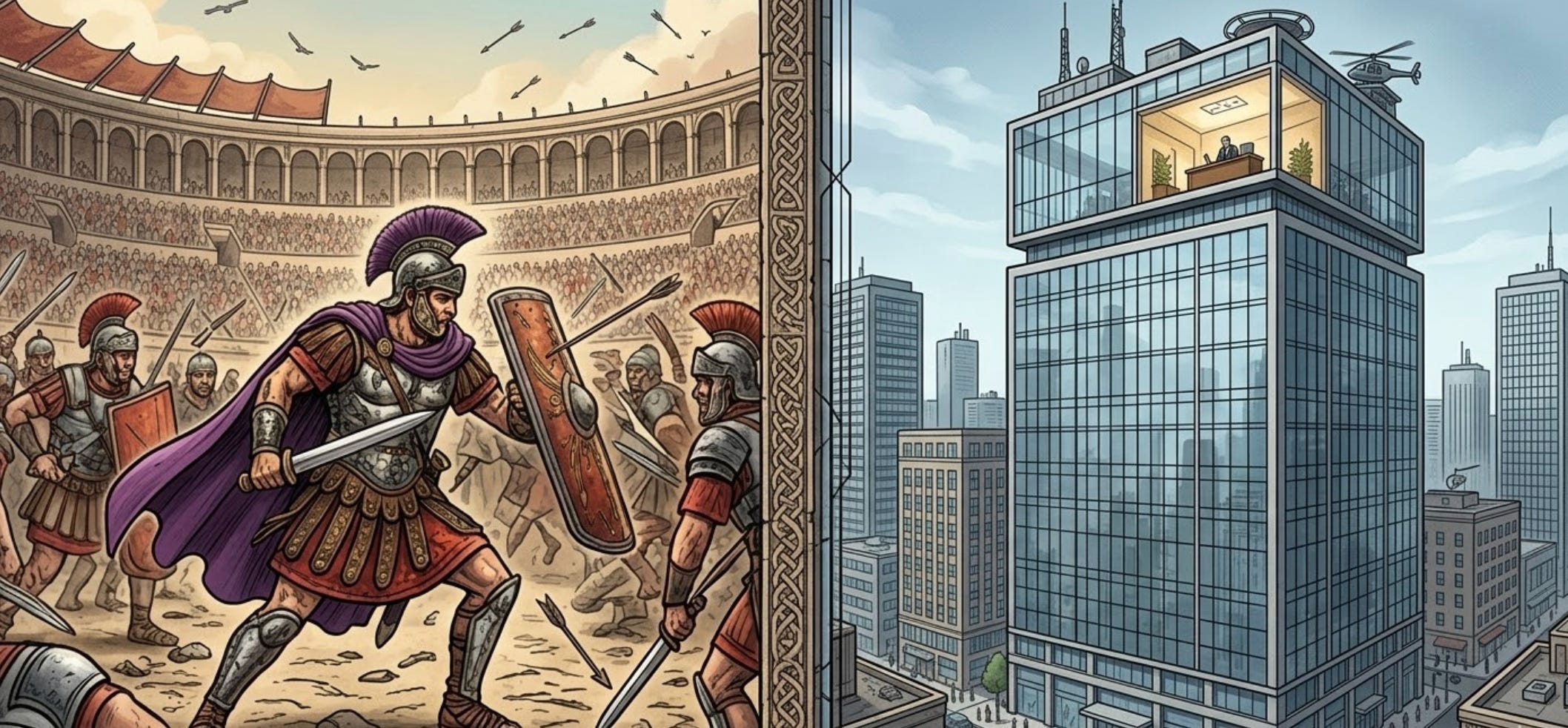
There is a framework from military strategy that I keep coming back to when I try to make sense of the current political landscape: the distinction between tactical, operational, and strategic levels of thinking.
Tactical is the immediate move - the press conference, the tweet, the manufactured outrage cycle. Operational is the campaign - the policies designed to win the next election, to hold power for one more cycle. Strategic is the why - the long-term purpose, the end-state, the world you are actually trying to build for the next generation.
The uncomfortable truth - and I say this with all the diplomatic restraint I can muster as someone from a region where diplomatic restraint is not exactly our national sport - is that our leaders on both sides of the Atlantic are stuck at the operational level. They are thinking about staying in power, not about what comes after. They have no strategic vision, just operational one. Not because they are stupid (some of them are, but that’s a separate issue), but because they lack the mental equipment for the challenges we face today, and - more fundamentally - because they have no skin in that particular game.
Roman Emperors Rarely Died of Old Age
Let me start with the most basic problem, because everything else flows from it.
In the Roman Empire, leadership came with a very tangible form of accountability: most emperors did not die peacefully in their beds. They died in battle, by assassination, or through the consequences of their own catastrophic decisions. The feedback loop between bad leadership and personal ruin was short and brutal. You could not afford to be complacent, because complacency got you killed.
Now look at our current crop of leaders. They enjoy the comfort and insulation of mid-level corporate managers in a large bureaucracy - good salary, excellent benefits, zero exposure to the consequences of their own decisions. They preside over policies that will shape the lives of billions for at least the next generation, but they themselves will be comfortably retired, giving speeches at €200,000 a pop and writing memoirs nobody reads, long before the bills come due. Also, has any - ANY - leader in the past several decades been held accountable for his bad leadership? Apart from the Romanians that (rightfully) executed Ceaușescu?
“Bureaucracy is a construction by which a person is conveniently separated from the consequences of his or her actions.” - Nassim Nicholas Taleb
That is exactly what we have built. A system where the people making the most consequential decisions are the ones least likely to suffer from getting them wrong.
Here is the thing that took me a while to understand, and that I think most people still don’t: systems do not learn because individuals inside them learn. That is the great myth of modernity. Systems learn by removing those who are not fit for purpose. Evolution does it through death. Markets do it through bankruptcy. Democracies are supposed to do it through elections. But what happens when the democratic mechanism itself gets captured?
Taleb has a line that could have been written specifically about our transatlantic political class: that the curse of modernity is the proliferation of people who are better at explaining than doing. Our leaders are superb at explaining why things went wrong after the fact. They are constitutionally incapable of understanding what is happening in real time, let alone acting on it. They are what Taleb calls “Bob Rubin traders” - they collect the upside when things go well and pass the downside to the rest of us when they don’t.
When your time horizon is “will I win the next election?” or “can I hold my coalition together for two more years?” you are structurally incapable of strategic thinking. Strategy requires accepting short-term costs for long-term gains. It requires investment, patience, and - yes - personal sacrifice. But if you are 75 years old and your political legacy is already written in your own mind, why would you sacrifice anything? You lived through the good times. You will not be around for the reckoning.
Trained for a World That No Longer Exists
The skin-in-the-game problem is compounded by something equally serious: the current generation of leaders was mentally formed in a world that has ceased to exist, and they do not have the cognitive flexibility to adapt to the one that replaced it.
Singapore’s Prime Minister Lawrence Wong articulated it well: we are living through a period where the old rules no longer apply, but the new rules have not been written yet. This is a period of profound transition - geopolitical, technological, economic - and it demands a kind of mental agility that is simply not available in many of our current leaders who built their entire worldview during the Cold War or its immediate aftermath.
Consider what they internalised:
American hegemony as a permanent feature of international life.
NATO as the unquestioned backbone of European security.
Economic interdependence as an unalloyed force for peace.
The inevitability of liberal democratic convergence.
Free trade as a near-theological good.
Every single one of these assumptions is now being stress-tested to the point of fracture, and the people who were shaped by them are the last ones capable of imagining what comes next.
This is not an insult, but a structural observation. Asking leaders who spent 40 years operating within a particular paradigm to suddenly think outside it is like asking a cavalry officer to command a drone squadron. The discipline is real, the experience is genuine - but the battlefield has changed so fundamentally that the old expertise becomes more of a liability than an asset.
The skills are different, so are the reflexes. And more importantly, accepting the new reality would require them to question the value of everything they spent their careers defending. Most people, understandably, cannot do that. That’s just human nature. So instead they double down. They cling to operational objectives - staying in office, maintaining the appearance of competence - while the strategic ground shifts beneath them.
The challenges we face - China’s industrial-military expansion, Russia’s war of attrition against the European security order, rising instability in the Middle East, the weaponisation of supply chains and economic interdependence - require rapid adaptation, institutional innovation, and the willingness to break with decades of established practice. Our current leadership class is trying to fight a 21st century strategic competition with a 20th century operating manual.
Eastern Europe: The Weight of Inherited Systems
Nowhere is the generational problem more visible than in the former Warsaw Pact countries, and I can speak to this with some authority because I grew up inside it.
Too many leaders in this region were formed by the Soviet system - not necessarily as ideological communists, but as people who learned how politics works under conditions of authoritarianism. They absorbed the logic of extractive governance: the state as something to be captured, networks of patronage as the natural order, public resources as private entitlements. These habits do not disappear simply because you adopt a new constitution and join the European Union. I have watched them operate my entire life.
Václav Havel understood this when he took over what was called Czechoslovakia at the time. When he came to power after the Velvet Revolution, he faced intense pressure to keep experienced administrators in place - people who “knew how the system worked.” Havel refused. He argued, memorably, that he would rather have honest amateurs than experienced collaborators. They knew how to navigate a corrupt system, not how to build a functional one.


Ukraine offers a compelling case study in real time. Look at Kyrylo Budanov, born in 1986, raised entirely in independent Ukraine - no Soviet baggage, no muscle memory of navigating authoritarian systems, only the clarity that comes from knowing exactly what you are fighting for. Or Mykhailo Fedorov, the new defence minister, born in 1991 - Ukraine’s youngest-ever minister, who came up not through the military establishment but through digital transformation, built the state’s drone procurement infrastructure, and now brings a technology-first mindset to a ministry that most countries still run like it is 1985.
These are not products of the old system, they are products of the transition itself. And they bring a level of mental agility and situational adaptability that their predecessors simply cannot replicate. That is not ageism, but an operational reality - and in Ukraine’s case, it is happening at an accelerated pace, because their very survival as a nation depends on it.
Anyone who has paid close attention to the war knows that one of Kyiv’s biggest domestic hurdles was purging the Soviet-mindset political apparatchiks from positions of authority. That is not something you can switch off with a policy change or a reform programme. It only happens by removing the people who still operate on the old logic and replacing them with people who don’t carry it. You can put the best hardware in the world, but it will not perform if it is running on legacy software.
Western Europe: When Process Becomes Purpose
Western Europe has a different version of the same disease. Here, the problem is not the legacy of authoritarianism but the legacy of unprecedented success.
The leaders who dominate European politics today came of age during the most peaceful, prosperous period in the continent’s history. They internalised the idea that this was the natural order of things. European integration was inevitable. The arc of history bent toward cooperation. Economic interdependence would make war impossible. They were wrong, and yet - they are still in charge. And they still cannot (or will not) fully process the return of hard power politics to European soil.
So they optimise process instead of outcomes. They debate regulatory frameworks while Russia mass-produces artillery shells, convene working groups while China cements its control of upstream supply chains. They manage electoral cycles while long-term strategic threats compound.
The European Union, for all its genuine achievements in pooled sovereignty and cooperative governance, has become a machine that is better at producing procedures than tangible results. It has the wealth, the industrial base, and the human capital to meet every challenge it faces - but what it lacks are leaders who understand that institutions are tools, not temples, and that sometimes you have to act with uncomfortable speed, even if the process isn’t perfect or fully compliant with your endless list of regulatory requirements.
Friedrich Merz, to his credit, put it bluntly at Davos in January: Germany and Europe have wasted incredible potential for growth by dragging their feet on reforms and excessively curtailing entrepreneurial freedoms. The single market, he said, was supposed to be the most competitive economic area in the world. Instead, Europe became the world champion of over-regulation.
The diagnosis is correct. But look at who is delivering it: a 70-year-old career politician from the CDU, a man formed entirely by the system he is now criticising. The question is whether anyone shaped by the old paradigm can actually dismantle it, or whether they will simply optimise it - tweak the regulations, rebrand the bureaucracy, hold another summit - and call it reform.
Where are Europe’s Budanovs? Where are the leaders who grew up after the Cold War, who understand digital-age conflict, who do not reflexively defer to Washington, who grasp that European strategic autonomy is not a seminar topic but an existential necessity? They exist. But they are blocked by a layer of political incumbents who view any challenge to their authority as a personal affront rather than as precisely the kind of renewal the moment demands.
Germany’s Starlink Problem: When Legacy Eats Strategy for Breakfast
If you want a perfect, concrete illustration of how the old guard operates even when it claims to be building for the future, look no further than SatcomBw-4 - Germany’s plan for a sovereign military satellite communications constellation.
The project itself makes total strategic sense - a network of around 100 satellites in low Earth orbit, designed to provide the Bundeswehr with secure, jam-resistant communications independent of American providers. Think of it as Germany’s answer to Starlink, except for military use. Target operational date: 2029. Price tag: around €8–10 billion. It is the largest space contract in German history, part of a broader €35 billion Bundeswehr space investment package.
All good so far, right? Here is where it gets interesting.
The Bundeswehr’s procurement office, the BAAINBw, sent out tender invitations and asked three companies to submit individual bids: Rheinmetall, OHB (a satellite manufacturer), and Airbus Defence and Space. The idea, presumably, was competitive bidding. Let the best proposal win. Let the market work!
Instead, the three companies looked at each other and decided to form a single consortium. One bid. Zero competition. Rheinmetall handles military systems integration, OHB builds the satellites, Airbus provides manufacturing capacity. According to reporting by Spiegel and Bloomberg, the BAAINBw received the news that instead of three competing proposals, it would be getting one joint offer. Take it or leave it.
The consortium argues this is about efficiency - only together can they handle the project’s scale and timeline. And to be fair, there is some logic to that. It also conveniently eliminates the legal disputes that would inevitably follow if one company won and the others sued. Very tidy. Very German.
But here is what nobody seems to want to say out loud: a direct award without competitive tender almost certainly means higher prices. And more importantly, it means that the same legacy giants who have been building European defence systems for decades - the Airbuses, the Thaleses, the Leonardos - get to keep their lock on the biggest contracts, regardless of whether they are the most innovative, the fastest, or the best value for money.
Think about what this looks like from the perspective of a European defence tech startup. You have spent years developing cutting-edge satellite technology, autonomous systems, or software-defined communications. You have venture funding. You have engineers who actually understand proliferated LEO architectures because they grew up with them, not because they read a McKinsey report about them. And you cannot get through the door, not because your technology isn’t good enough, but because the door is not designed to open for you.
A recent Bruegel policy brief put the numbers on it: in selected European countries, defence procurement is primarily directed at the top-ten companies, with typically less than 30% of total order volume going to everyone else. McKinsey’s research on European defence tech startups documents what founders have been saying for years: government procurement processes are complicated, country-specific, and administration-heavy, placing enormous costs and requirements on young companies that lack the resources to navigate them. The system, as the EU Commission itself acknowledged in its Defence Industry Transformation Roadmap, has a “very slow and cumbersome” innovation cycle.
Meanwhile, Ukraine - you know, the country actually fighting the largest land war since WWII - is running containerised 3D printing facilities near the front lines, designing and deploying drone countermeasures within hours. Their defence minister came from digital transformation, not from the military-industrial establishment. The contrast could not be starker.
This is not just a procurement problem, but a generational problem showing up in industry. The same mentality that keeps 75-year-old leaders in political office keeps 50-year-old defence conglomerates at the top of every tender list. The same instinct that says “we need experienced hands” in politics says “we need proven primes” in defence contracting. And the result is the same: systems optimised for the last war, not the next one.
Merz stands at Davos and declares that Europe has become the world champion of over-regulation. Then his own government’s procurement office prepares to hand a €10 billion no-competition contract to a consortium of legacy players. The irony is so thick you could spread it on bread. But nobody laughs, because the strategic consequences are not funny at all.
We are supposed to be re-arming and re-industrialising on an accelerated timeline. We are supposed to be building defence capacity that can deter Russia, reduce dependence on America, and compete with China. And we are doing it by handing the keys to the same companies that optimised for peacetime margins, returned capital to shareholders through buybacks instead of investing in R&D, and treated surge capacity as waste for two decades. By 2025, European defence primes were still prioritising dividends and buybacks to the tune of $5 billion, at a time when we need to turbocharge innovation and production.
It is time for the old to give space for the young to demonstrate their abilities. Not because the old are not good - Airbus builds perfectly fine satellites - but because the battlefield has changed, the technology has changed, and the timeline has changed. We do not have the luxury of 15-year procurement cycles anymore. We do not have the luxury of consortium comfort deals. We have, at best, a few years to build what we should have been building for the last twenty.
America: Tactical Brilliance, Strategic Bankruptcy
And then there is the United States, which has managed the remarkable feat of going from global hegemon to something that increasingly resembles a continentalist power in retreat - torching alliances, hollowing out scientific institutions, and conducting foreign policy as though it were a real estate transaction. And yes, I do understand that this is just the current Trump administration, but that administration currently governs from the Oval Office with a mandate of around 80 million votes.
The current American leadership exemplifies the problem in its purest form. Tactically, the moves are often brilliant - dominating the news cycle, energising political bases, wrong-footing opponents. Operationally, everything is subordinated to the goal of maintaining power. But strategically? There is nothing. Slogans do not constitute strategy, and policies that actively destroy American soft power, undermine the global alliance system, and threaten the dollar’s reserve currency status are not “America First” - they are America stabbing itself in the back (and ironically, calling it a victory! Go figure).
The United States is blowing its greatest strengths: its global alliance system, its scientific capability, its soft power. These are not recoverable assets. Once you make errors of this magnitude, future decisions will be made from a worse position than what was previously available. These are own goals, and they are being scored by people who will not live long enough to play the next match.
The American political class, like its European counterpart, skews elderly. The gerontocracy is transatlantic. And these leaders - whether consciously or not - are optimising for their own legacies and their own remaining years, not for the security of the generations that will inherit the consequences.
The Rent-Seekers’ Last Stand

There is a distinction in economics between those who take risks and those who seek rents.
Our current leadership class, in both politics and industry, is dominated by rent-seekers. They did not build the post-1945 liberal order - that was the achievement of a much greater generation. They did not fight for the freedoms and institutions they now claim to defend. They inherited all of it and grew up enjoying it as a default setting. And now they are extracting the last remaining value from those institutions - burning through accumulated strategic capital, running down defence-industrial capacity, hollowing out the very structures that made Western prosperity possible - while positioning themselves to exit before the collapse becomes undeniable.
I am not saying this as an exercise in my Balkan cynicism, although God knows the region provides ample training. I was raised to respect elders and seek their wisdom. It gives me no pleasure to write these words. But the observable reality is the observable reality. When I look at an 80-year-old leader dismantling alliances that took decades to build, I see someone whose time horizon is simply too short to care about the long-term, whose mental models were formed in a different era, and whose personal incentives are entirely disconnected from the collective interest. When I see a consortium of legacy defence contractors stitch up a €10 billion contract without competition, I see the industrial equivalent of the same problem.
That is the definition of a system without skin in the game.
The Case for Generational Renewal
Let me be clear about what I am arguing and what I am not.
This is not a case for age discrimination! There are brilliant strategic minds at every age, and accumulated wisdom matters. Nor is it an argument that youth automatically equals competence - history is littered with young leaders who were spectacularly terrible.
What I am arguing is something more specific and, I think, more urgent.
The current generation of leaders - in politics and in the industrial establishment - is not equipped, as a class, for the challenges we face. They were trained for a different world. Their cognitive reflexes are calibrated to a set of conditions that no longer exist. And they have no personal stake in the long-term consequences of their decisions.
Sometimes you need new people, not because the old ones are incompetent in some abstract sense, but because their competence is tuned to the wrong frequency. A person who knows how to navigate the old system brilliantly may be precisely the wrong person to build the new one. Churchill was an excellent wartime leader - but he lost the 1945 election because the public understood, even if he didn’t, that winning the peace required different skills than winning the war.
In Eastern Europe, this means completing the generational transition that began in 1989 but was never fully carried through - replacing the remnants of extractive, Soviet-era political culture with leaders who view the state as something to build, not to loot.
In Western Europe, it means elevating leaders who understand that the post-Cold War peace dividend is over, that defence is not optional but existential, and that European strategic autonomy must move from academic aspiration to operational reality. It also means opening defence procurement to companies that can actually innovate at the speed the threat demands, not just the ones with the largest lobbying budgets and the longest relationship with the procurement office.
In America, it means breaking the stranglehold of a generation that benefited more than any in human history from the liberal international order and is now, through a combination of short-termism and strategic illiteracy, dismantling it.
The Clock Is Ticking
History does not end, and every generation must eventually step up.
The question is whether we allow the current leadership class - and the industrial incumbents that serve them - to sleepwalk us into catastrophe, or whether we force a changing of the guard while there is still time and still enough institutional capital left to build with.
Not through revolution. Through relentless democratic pressure. Through insisting that the people who will live with the consequences get a seat at the table where the decisions are made.
The old rules no longer apply, and the new ones are not yet written. The people currently in charge - not necessarily through fault of character, but through the simple mathematics of age, incentive, and cognitive formation - are constitutionally incapable of writing them.
Never trust anyone who doesn’t have skin in the game. They will eventually pay for things using your money.
We are paying. It is time to make room for those who will have to live with the bill.
"systems do not learn because individuals inside them learn... Systems learn by removing those who are not fit for purpose."
Relatedly: as Max Planck supposedly said: "science advances one funeral at a time."
You could probably replace "science" with terms from other fields
Excellent article:
Reminded me in some parts of the quote: “An economist is an expert who will know tomorrow why the things he predicted yesterday didn't happen today” which seems very fitting.
What you’re describing here is a systems optimization progression that most human organizations go through, when these organizations reach a certain stage of the evolution, their primary concern becomes self-preservation. Through a series of internal pressures, adaptations and systems processes that evolve over time, they perpetuate the circumstances to enhance their chances of remaining in existence and resisting change.
One of those is optimizing for people that fit within the systems without breaking them, and that help perpetuate them. So in your example, European politicians fit that paradigm to a tee: if they were to do otherwise they would face pressure that, as you said, would lose them personally their positions, force them to have skin in the game. They would also face heavy resistance if the were to attempt to introduce too much changes in the systems, which they are incentivized against.
I have had the privilege of being both inside and outside similar bureaucratic systems, and the view from the inside is tremendously tunnel vision through contextualization; things that look obvious from the outside are sometimes invisible from the inside, and at other times you can see them but you know it would incur a cost on you personally if you were to try to affect change.
A very interesting read.