
The Second Front: Why Iran is not Iraq, why Europe has the most to lose, and how the world just changed
On Iran, the ethics of intervention, and the war we are already in.

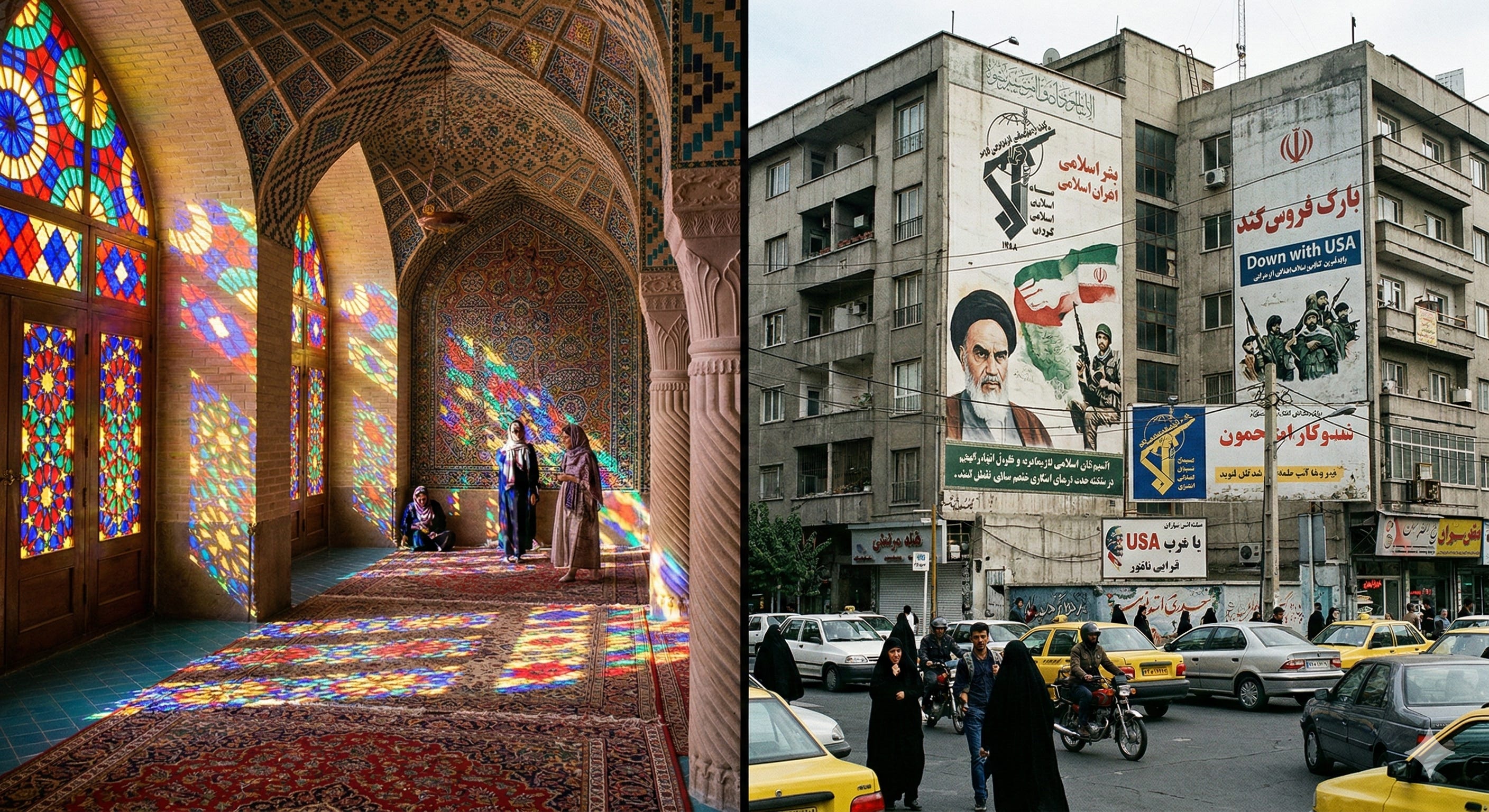
There is a distinction that a lot of geopolitical commentators fail to make - and it is a distinction that every Iranian I have ever met makes instinctively, with pain in their voice. Iran is not the Islamic Republic. Persia is not the IRGC. The civilisation that gave the world algebra, poetry, and wine is not the theocratic apparatus that has spent four decades strangling it. If you take nothing else from this piece, take this: the Iranian diaspora dancing on the streets of Berlin, London, and Los Angeles when they heard the news of Khamenei’s death were not celebrating the destruction of their country. They have spent years and decades mourning what was done to it - and hoping that the nightmare might finally end.
I need you to hold that distinction in your mind for everything that follows. Because what I am about to write will make some of you uncomfortable, regardless of where you sit on the political spectrum.
A Personal Preface
I don’t share a political ideology. I have never belonged to a party, never will. My politics are issue-dependent, and they are downstream of a single thing: my ethical framework. That framework was forged in a country that was wrecked by an authoritarian regime - a secular one, wrapped in the language of equality and progress, that left my country economically gutted, institutionally hollowed, and psychologically scarred for generations. Communism did that to my nation. I watched the aftermath, and as the years rolled into decades, I realized it takes generations for that damage to be repaired. I know what authoritarian decay looks like - not from textbooks, but from the fabric of daily life in a country still recovering decades later.
And so when I tell you that I loathe authoritarian regimes, understand that this is not an ideological posture. It is a visceral, bone-deep conviction born of lived experience. It does not matter to me whether the boot on your neck wears a hammer and sickle or wraps itself in religious scripture. A boot is a boot.
I have been to Iran. Physically. In 2015, I travelled extensively through the country - Tehran, Isfahan, Shiraz, Yazd, Kashan, and small towns and villages in between. I walked through bazaars older than many modern nations. I ate with families who opened their homes to a stranger with a generosity that still humbles me when I think about it. I saw a civilisation of extraordinary depth and beauty held hostage by a theocratic regime that used brutal violence, intimidation, and surveillance against its own people. The women I met navigated a daily minefield of restrictions with fierce dignity that I have never forgotten. The young men spoke about futures they could not build. The disconnect between the warmth and sophistication of the people and the brutality of the system governing them was unlike anything I had encountered - and I grew up in post-communist Eastern Europe, so my bar for institutional disillusionment is not exactly low.
That trip shaped how I process everything that is happening right now. Because when I read the reports about what the Islamic regime did to its own citizens between December 2025 and January 2026, I am not processing abstract statistics. Bodies piled in the morgues or streets, thousands of families searching through black bags to find their loved ones. Children shot. Wounded protesters finished off in the streets and in hospitals.
Given the barbarity of this regime - a regime that massacred its own people on a scale not seen in Iran since the 1979 bloody revolution - bringing it down is not just a geopolitical calculation, but an ethical one.
The Moral Erosion of the West
There was a time - and it was not so long ago - when the Western world maintained a more robust moral stance towards authoritarian regimes and the barbarians who run them. Imperfect? Absolutely. Hypocritical at times? Without question. But there was at least a baseline consensus that certain behaviour placed you beyond the pale of legitimate international engagement.
That consensus has been eroding for years, and the erosion has come from all sides.
Obama made a nuclear deal with the mullahs. Trump tried - desperately - to get his own. The pattern extends well beyond Iran. We watched Russia annex Georgian territory in 2008 and did nothing meaningful. We watched Russia annex Crimea in 2014 and imposed sanctions that amounted to a diplomatic wrist-slap. We watched China systematically violate every WTO commitment it had made - intellectual property theft, forced technology transfers, market manipulation on an industrial scale - and we looked the other way because cheap goods were more important than principles and our rules-based order. We are watching Western leaders attempt to engage with al-Jolani in Syria as though his rebranding from al-Qaeda affiliate to statesman is anything more than changing a turban for a tailored suit.
More and more of our leaders - and unfortunately, more and more of our citizens - have convinced themselves that you can negotiate in good faith with bad faith actors. That you can “deal” with regimes that see diplomacy as a tactical tool for buying time while they consolidate power, build weapons, fund proxies, and crush dissent. The illusion of peace has become more comfortable than the cost of confronting what actually threatens it.
And the moment we raised our hands and declared we were no longer truly interested in defending the rules-based international order - the green light for every despot on the planet went on. Georgia. Crimea. The South China Sea. Hong Kong. Syria. And now, the inevitable conclusion: a regime that felt so emboldened, so confident in Western inaction, that it turned machine guns on unarmed civilians in its own streets and expected the world to issue strongly worded statements and move on.
The Strike: Necessary, Illegal, and Inevitable
Let me be blunt - I have no interest in hedging.
Was the joint US-Israeli strike on Iran legal under international law? No.
Was it conducted in coordination with the proper multilateral institutions? Also no.
Was it a necessary evil in a world where the old rules have collapsed and the new ones have not yet been written? I believe it was.
That last phrase is not mine. It belongs to Singapore’s Prime Minister Lawrence Wong, who said it at the Bloomberg New Economy Forum in November 2025, describing the post-American world order: “The old rules no longer apply, but the new ones have not been written.” He was talking about the collapse of the unipolar moment, the end of American-underwritten global stability, and the terrifying vacuum that has replaced it.
This is reality. You can argue about its legality until the end of time. But legality presupposes a functioning legal order, and as PM Wong correctly identified, that order is gone. We are in the interregnum. And in the interregnum, power - raw, military, kinetic power - fills the gaps that law has vacated.
No Single Cause: Multiple Actors, Multiple Interests
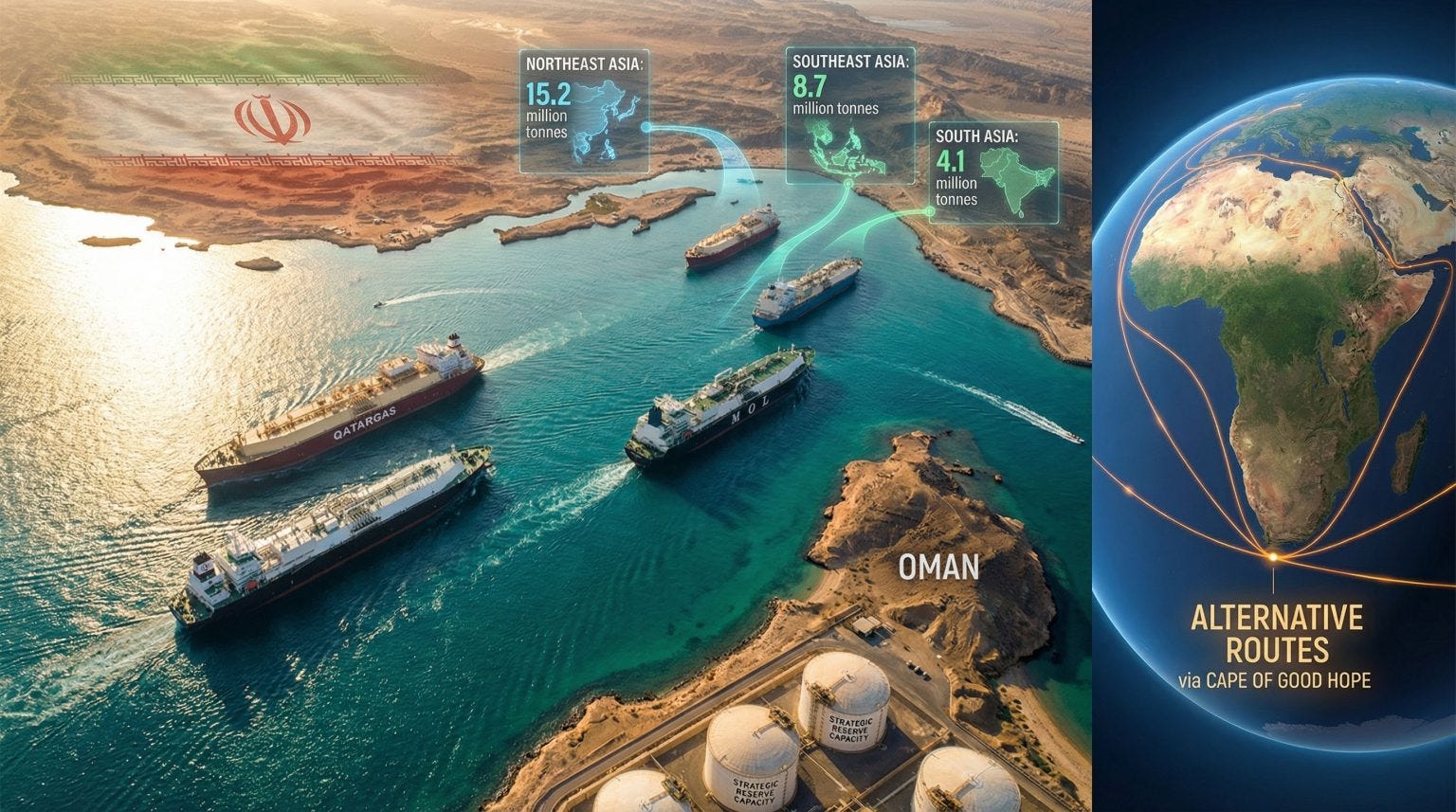
If anyone - any commentator, any politician, any talking head - sells you a singular reason for why this is happening, they are lying to you. Or they are too intellectually lazy to grapple with the actual complexity of the situation. Every actor involved in this new front of what I increasingly call the New World War has their own reasons, their own calculations, and their own desired outcomes.
The United States: Containing China
The US did not strike Iran to liberate the Iranian people, however much the rhetoric might suggest otherwise. The strategic logic is primarily aimed at Washington’s greatest long-term adversary: China.
China is an extraordinarily import-dependent economy. It imported a record 11.6 million barrels of crude oil per day in 2025. More than 80% of Iran’s shipped crude went to China, representing approximately 1.4 million barrels per day. Iran is not just a source of cheap, sanctioned oil for Chinese independent refiners. It is a node in a broader network of sanctions-evasion supply chains that includes Venezuela and Russia - supply chains that give Beijing a structural cost advantage and strategic flexibility that Washington has been trying to disrupt.
The Venezuelan operation in January - Maduro’s removal, the maritime blockade - was Act One. Iran is Act Two. If you look at these moves in sequence, the pattern is unmistakable: Washington is systematically targeting the cheap energy sources that underpin China’s economic model. Whether this strategy succeeds is another question entirely. China has been stockpiling aggressively - building over 169 million barrels of new storage capacity in 2025-2026 alone - and has demonstrated the ability to substitute Russian crude for disrupted supplies almost barrel-for-barrel. But the intent is clear: raise China’s energy costs, disrupt its supply chains, and force it into a more expensive and vulnerable position in the broader great power competition.
Israel: Survival
Israel’s calculus is both simpler and more existential. For Israel, Iran is not a distant strategic competitor, but an immediate, mortal threat.
I am not even talking about the nuclear program. The core of the threat is the IRGC’s decades-long, billions-of-dollars project to build, fund, arm, and train a constellation of proxy forces designed to encircle and bleed Israel: Hezbollah in Lebanon, Hamas in Gaza, the Houthis in Yemen, and various militia groups across Iraq and Syria. These are not abstract threats: October 7th happened, rockets flew from Lebanon, the Houthi attacked the Red Sea shipping. For Israel, dismantling the command structure and military infrastructure of the regime that funds and coordinates all of this is the logical conclusion of a survival strategy that has been decades in the making.
The Israeli military’s announcement that it killed 40 senior Iranian commanders, including the Chief of Staff, in the opening wave of strikes tells you everything about the nature of this operation - this was a decapitation strategy, planned with intelligence depth that suggests years of preparation.
Europe: The Reluctant Stakeholder With the Most to Lose
And then there is hesitant Europe.
European leaders have been remarkably measured in their public statements. France, Germany, and the UK issued a joint statement that neither explicitly supported nor condemned the strikes, while carefully condemning Iran’s retaliation.
There are political reasons for this reticence. The current US administration is not exactly popular on the continent. European citizenry - and therefore European politicians - are suffering from a severe case of what I call Iraq Syndrome: the reflexive assumption that every Western military intervention in the Middle East is destined to become a new Iraq. The catastrophe of Iraq that destabilised the entire region and caused wave after wave of refugees to the old continent, created a trauma in the European psyche that has calcified into a mental model which Europeans apply to every subsequent situation, regardless of how different the context, the culture, the strategic environment, or the operational design may be.
But here is what European leaders know and are reluctant to say publicly: Europe has more at stake in this conflict than the United States.
First, geography. The Middle East is Europe’s southern backyard. The Americans are an ocean away. When things go catastrophically wrong in that region - and they have, repeatedly - it is not American cities that absorb the human consequences. It is European ones.
Second, trade. Massive volumes of European commerce flow through the Red Sea chokepoints. The Houthis demonstrated in 2024 just how vulnerable those routes are - ships are already avoiding the waterway.
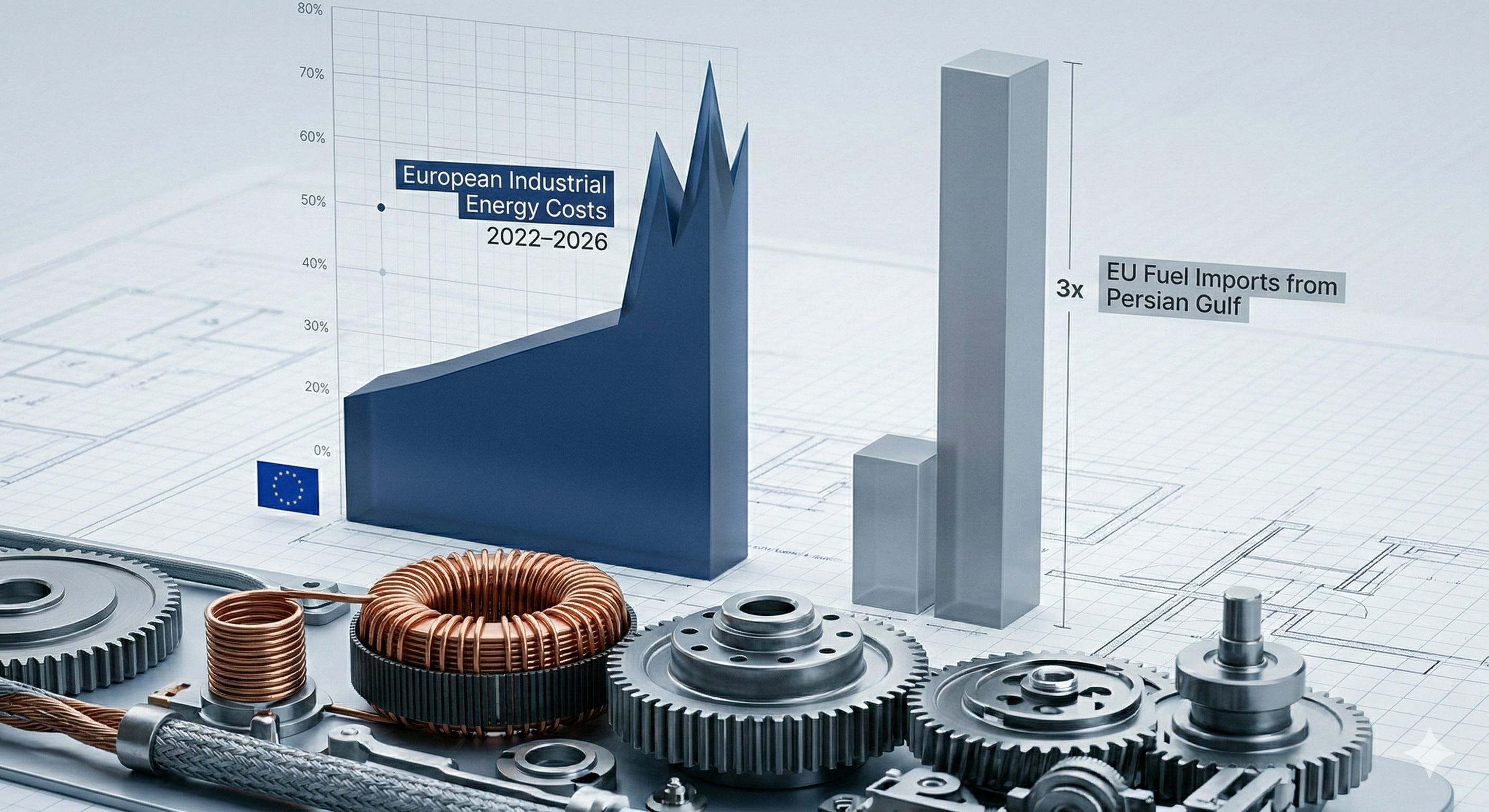
Third - and this is the big one - energy. Europe is in the grip of a severe energy crisis. Since replacing Russian supplies after 2022, EU fuel imports from Persian Gulf countries have more than tripled, reaching approximately €58.4 billion. Europe has the highest energy prices in the developed world, rendering its industry uncompetitive against both the United States and China. This is not a cyclical problem, it is a structural one, and it is slowly deindustrialising the continent during a time when industrialisation is critical.
Now consider the upside scenario - and yes, it is a significant “if.” If this military operation results in the collapse of the theocratic regime and a transition to a more moderate, outward-looking government, the implications for Europe would be transformative. Iran has a long history of cooperating with Europe. Much of Iran’s modern infrastructure was built with French and German engineering. A post-theocratic Iran that reintegrates into the global economy would be a massive energy supplier, a major market, and a stabilising force in the region.
The proxy wars that have weaponised migration against Europe - funded and coordinated by the IRGC - would lose their patron. The Red Sea would become safer. Energy diversification would accelerate. The entire calculus of European competitiveness would shift.
Europe has a hell of a lot more to both win and lose in this war than the talking heads are telling you. And the fact that European leaders are not saying this publicly does not mean they do not know it. It means they are terrified of their own electorates, trapped by Iraq Syndrome, and paralysed by the political risk of aligning - even tactically - with an American administration that is openly hostile towards Europe, and one that most European citizens (rightfully) despise.
This, by the way, is precisely the kind of operational thinking masquerading as strategy that I write about relentlessly on this publication. Too many European leaders are optimising for the next election, not for the next decade(s). They cannot see past the current news cycle to the structural forces that will determine whether Europe remains a relevant economic power or slides into permanent strategic dependence.
This Is Not Trump’s War
One point I want to make emphatically, because it matters for how we understand what is happening: I do not treat this as something done by Trump.
Yes, his name is on it. Yes, he announced Khamenei’s death on social media with characteristic bombast. Yes, he will take credit for everything that goes well and blame others for everything that does not.
But this operation has the Pentagon written all over it. The scale of the military buildup - the largest in the Middle East since 2003, with two carrier strike groups, over 150 aircraft, 13 Arleigh Burke-class destroyers, F-22 Raptors deployed to Israeli air bases, and Jordan’s Muwaffaq al-Salti base transformed into a major operations hub with over 60 strike aircraft - this is not something that was drawn up at Mar-a-Lago. This is years of contingency planning brought to execution.
Multiple credible sources have reported that Trump had to be brought to that particular table - one, that he did not want to sit on, because he prefers deals over military intervention. That’s what he promised his voters.
I would argue in good faith that dealing with Iran has been on the Pentagon’s planning books for a very long time - likely decades. The question was never “if” but “when” and “under what conditions.” Trump’s contribution was signing off.
Trump is hoping it goes well so he can take credit. That is what politicians do. But do not confuse the signature on the order with the architecture of the operation. I have no stomach for politicians who cannot think past the next election cycle. But I have respect for military generals who can think long-term - and this operation, whatever its outcome, bears the hallmarks of long-term strategic planning.
Iran Is Not Iraq. And It Is Not Syria.
This must be said clearly, for those whose Middle East mental model consists of a single undifferentiated blob of “failed states.”
Iran is a nation with one of the oldest continuous civilisational traditions on Earth. It has institutions - judicial, educational, bureaucratic - that predate the Islamic Republic by centuries. It has a highly educated population, a sophisticated middle class, and a diaspora that is one of the most successful immigrant communities in the world. It has ethnic complexity - Persians, Azeris, Kurds, etc. - but it also has a national identity that has survived Mongol invasions, Arab conquests, and four decades of theocratic misrule.
This is not Syria, where decades of Baathist rule hollowed out every institution and left nothing but sectarian fault lines. This is not Iraq, where Saddam’s totalitarian apparatus was the only thing holding together a country drawn on a map by British colonial administrators who had never visited it.
The question of what comes after the mullahs is legitimate, urgent, and genuinely difficult. Who leads a transitional government? What role does the military play? Can the IRGC’s economic empire - estimated at controlling up to a third of Iran’s economy - be dismantled? Will ethnic tensions, suppressed for decades, explode? Will the exiled opposition, led by figures like Crown Prince Reza Pahlavi, command enough legitimacy inside the country to stabilise a transition?
These are real questions, and I do not pretend to have the answers. But the framing matters. Iran has the raw materials for a functional post-theocratic state in a way that Iraq and Syria never did. Whether those materials can be assembled into something viable will depend on decisions that have not yet been made, by actors who have not yet emerged, under conditions that are still being shaped by the bombs falling on Tehran as I write this.
The Fog of an Unfinished War
The situation is extraordinarily volatile. As of this writing, the US-Israel has struck over 1,000 targets in Iran. Iran has retaliated with missile strikes against Israel, US and French bases in Bahrain, Kuwait, Qatar, and the UAE. Cyprus and Turkey have also been hit. Even Oman - a country known for its neutrality in the region - intercepted missiles. Three US service members have been killed. Dubai’s airport - one of the world’s busiest - has been shut down indefinitely. The Strait of Hormuz may or may not be effectively closed. Oil markets will tell us what the world really thinks. Britain has authorised the use of its bases for defensive strikes. Iran’s retaliatory attacks have hit civilian targets across the Gulf.
This can go very well or very badly. It is far too early to tell. The military phase will likely take months, not days. And then comes the political phase - and that is where the real dangers lie. Every successful military campaign in history that was not followed by competent political reconstruction became a cautionary tale. The Americans should know this better than anyone.
The World Is Changing. Whether You Like It or Not
Let me close with the only thing I know for certain.
Whether you approve of this military intervention or not is, at this point, irrelevant. Whether it goes well or badly - irrelevant to the fact of its existence. It is happening. The second front of this New World War - call it a new Cold War if you prefer the less alarming label - is officially open. Ukraine, Israel, Venezuela, Iran - they are not separate, they are connected into a singular global confrontation between the Western world (Europe, North America and East Asian allies) and the Eastern one (Russia-China-Iran axis).
The world that existed before February 28, 2026 (or more likely - February 24, 2022) is gone. The Strait of Hormuz is contested. Iran’s supreme leader is dead. The IRGC’s command structure has been decapitated. Global energy markets are in turmoil. The rules-based order that was already on life support has had the plug pulled.
And yet - Iran’s ancient civilisation endures. Its people, who danced at funerals as an act of resistance, who toppled a monument to Khomeini in Yasuj while bombs were still falling, who chanted for freedom while security forces loaded their rifles - those people are still there. Whatever comes next will be built by them, for better or worse.
Pray for the best. Prepare for the worst. That would always be my advice.
And if you are European - don’t despair about our dear continent. When the dust of war settles and peace eventually emerges, it will be our expertise in institution building that would be most valuable. Wars are fought with drones and missiles, but peace is built with institutions, rules, and cooperation.
Best analysis on the Internet Today! And there is a lot of commentary out there.
Your strategic method of laying out the facts........and then connecting those dots.......just makes common sense.
Thank You!!!
Thank you for making a thoughtful point about Iran not being Iraq. WAY TOO MANY people just automatically draw their comparisons to right to Iraq when almost anything happens anywhere frankly… Great piece :)