
The Comfortable Class Part Deux: The American Edition
What Federalist 51 told us about the American system - and can the republic survive?

This is part II of my previous essay, the Comfortable Class, with a focus on the American political comfortable class.
DISCLAIMER: in this analysis, I will focus on the Republican Party of the United States of America, because since 2026, the Republican Party (GOP) holds a "trifecta" in the United States federal government, controlling the presidency (Executive) and majorities in both the House of Representatives and the Senate (Legislative). While they do not directly control the independent Supreme Court (Judicial), a majority of its justices were appointed by Republican presidents. I have my own opinions about the Democratic party, which - for now - I will keep to myself since they are not the focus on this analysis, and the Democratic party doesn’t hold the trifecta.
“A republic, if you can keep it.”
- Benjamin Franklin’s response to the question of what kind of government the delegates had given the country.
That is what Benjamin Franklin reportedly replied to as he walked out of the Constitutional Convention in 1787.
Franklin knew exactly what he was saying - republics are conditional, they require maintenance. The whole sentence is a conditional, actually - a great big “if” sitting at the centre of the American experiment for over two centuries.
I have been wrestling with the question of whether America can keep its republic for a very long time now. Longer, honestly, than I have been writing publicly. Anyone who has read me knows I am not a declinist by temperament. After all, the American system has surprised the world before - it has more antifragility in its bones than the doomers give it credit for.
But antifragility is not a magic pill, but a function of design. And the question I cannot put down is whether the design itself - the actual constitutional architecture the Founders built in 1787 - is antifragile enough to survive the specific kind of shock it is now absorbing.
So earlier this year, I went back to the source.
The Federalist Paper Trail
When I want to understand a system, I rarely read commentary about the system, I read what the people who built it actually wrote. This is a habit I picked up in my early 20s, when I realised that most analysts and tenured professors have the tendency of layering so many of their own preoccupations on top of the original material that the original material had effectively disappeared.
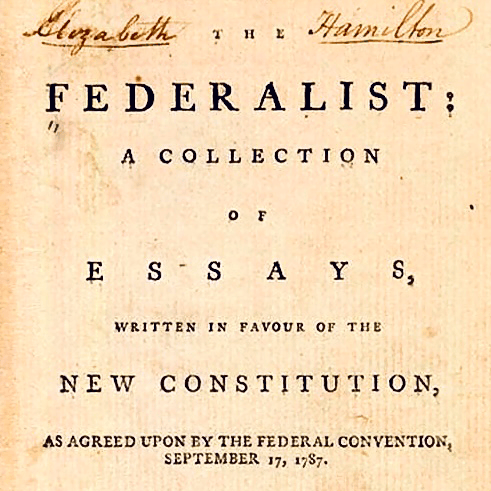
So I read the Federalist Papers. And then, because you cannot understand a debate by reading one side of it, I read the Anti-Federalists papers as well. Brutus, the Federal Farmer, Centinel, Cato. Read them in succession for better clarity. They are not always elegant - some of the Anti-Federalist essays are grouchy and provincial in a way - but together they give you something a modern writer has yet to give me: a clear, unfiltered view of how the United States came to be and how it was meant to function. The arguments are all there, so are the fears, the compromises, all of it. You don’t need anything else, but a cup of tea and an in-depth dive to comprehend the inception and evolution of the American republic.
Earlier this year, I re-read the Federalist Papers cover to cover. I wanted to know whether what I was watching unfold was a pathology the system was designed to handle, or a pathology the system was specifically not designed to handle. There is a difference, and it is the most important difference in American politics right now.
I want to focus on one essay, because in my humble view - it contains the entire bet the Founders made. Federalist 51.
Federalist 51 by James Madison: An Analysis
Federalist 51 was written by James Madison and published in February 1788. It is a short essay, and also one of the most important pieces of political philosophy ever written by an American, and I am willing to die on that hill. Below, I have done a deep-dive analysis:
Section 1
The problem: how do you keep power divided in practice?
"TO WHAT expedient, then, shall we finally resort, for maintaining in practice the necessary partition of power among the several departments… the defect must be supplied, by so contriving the interior structure of the government as that its several constituent parts may, by their mutual relations, be the means of keeping each other in their proper places."
Madison opens with a candid admission: the Constitution's stated separation of powers is not self-enforcing. Parchment isn’t enough, the real solution must come from structural design: building rivalry and mutual dependence directly into how the government works. This sets the stage for everything that follows.
Section 2
Principle 1: each branch should choose its own members
"Each department should have a will of its own; and consequently should be so constituted that the members of each should have as little agency as possible in the appointment of the members of the others."
Each branch must derive its authority independently - ideally from the people directly, through separate channels. Madison admits the judiciary is a partial exception (lifetime tenure plus specialised qualifications), but the principle holds: a branch picked by another branch is a branch owned by it. Today, this is formally intact but practically eroded - Republican members of Congress aren't appointed by the president, but their political survival depends on his endorsement, which produces the same loss of independent will Madison feared.
Section 3
Principle 2: pay each branch independently
“Were the executive magistrate, or the judges, not independent of the legislature in this particular, their independence in every other would be merely nominal.“
If one branch can starve another, formal independence is meaningless. Money is, after all, leverage. The Constitution prevents Congress from cutting presidential or judicial salaries mid-term for exactly this reason. The modern parallel: campaign finance and party infrastructure now do what salary manipulation once did. A senator who crosses the party leader doesn’t get his pay cut - he gets primaried. Different mechanism, same coercive effect on independence.
Section 4
The central mechanism: “Ambition must counteract ambition.”
“Ambition must be made to counteract ambition. The interest of the man must be connected with the constitutional rights of the place… If men were angels, no government would be necessary. If angels were to govern men, neither external nor internal controls on government would be necessary.”
Madison doesn’t trust officials to be virtuous - he trusts them to be selfish, and designs the government so that selfishness produces accountability. A senator should personally want to defend the Senate’s prerogatives because his own power, prestige, and identity are tied to that institution. The system breaks when the most relevant ambition shifts from institutional to partisan. When a senator’s career depends more on the party leader’s approval than on the Senate’s authority, the rivalry Madison engineered collapses. This is the precise diagnostic for the GOP question - the constitutional means still exist, but the personal motives have been rewired.
Section 5
Government must control itself
“You must first enable the government to control the governed; and in the next place oblige it to control itself. A dependence on the people is, no doubt, the primary control on the government; but experience has taught mankind the necessity of auxiliary precautions.”
Two layers of control: elections (the people) and internal checks (the auxiliary precautions). Madison is explicit that elections alone are insufficient - you can’t wait every two or four years to discover whether the system is working. The auxiliary precautions are what operate between elections. When defenders of executive overreach say “the next election will sort it out,” they’re discarding exactly the layer Madison thought was indispensable.
Section 6
Realism about human nature: self-interest as a public sentinel
“The constant aim is to divide and arrange the several offices in such a manner as that each may be a check on the other - that the private interest of every individual may be a sentinel over the public rights.“
Madison’s most cynical and most brilliant move: stop hoping for civic virtue, harness selfishness instead. Each official’s private interest becomes the guard on public rights. The flaw exposed today: Madison assumed the most relevant private interest would be institutional. He didn’t anticipate a media and primary system that would make partisan loyalty more career-determining than institutional defense.
Section 7
Congress split
“In republican government, the legislative authority necessarily predominates. The remedy for this inconveniency is to divide the legislature into different branches…”
Madison expected Congress to be so dominant that splitting it into House and Senate was necessary to prevent legislative tyranny. However, Congress is now structurally the weakest branch, having delegated war powers, trade authority, emergency powers, and rule-making to the executive over decades. The branch Madison feared would crush the others has been crushed by the one he thought needed fortifying. This isn’t the system working as designed. but the design being progressively dismantled.
Section 8
Veto power as a form of executive fortification
“As the weight of the legislative authority requires that it should be thus divided, the weakness of the executive may require, on the other hand, that it should be fortified.“
Madison gave the president the veto because he worried the executive was the weak branch needing protection from legislative encroachment. Imagine telling him that 235 years later, presidents would set tariff policy by proclamation, redirect funds via emergency declarations, and conduct wars without authorisation. The fortified-weak branch became dominant, and the dominant branch became dependent.
Section 9
Vertical division of power: federalism stacks on separation
“The power surrendered by the people is first divided between two distinct governments, and then the portion allotted to each subdivided among distinct and separate departments. Hence a double security arises to the rights of the people.“
Power is split horizontally (between branches) and vertically (between federal and state governments). If one layer fails, the other still operates. This is the part of Madison’s design currently doing the most visible work - state attorneys general suing the federal government, governors refusing to cooperate with federal policy, states acting as policy laboratories and legal counterweights. Whether you see this as healthy double-security or as fragmentation depends on which administration is being resisted, but the mechanism is functioning.
Section 10
Protecting the minority from the majority
“The society itself will be broken into so many parts, interests, and classes of citizens, that the rights of individuals, or of the minority, will be in little danger from interested combinations of the majority.“
The crux of Madison’s bet: a large, diverse republic is harder to capture than a small homogeneous one because no single faction can assemble a stable majority. Diversity itself becomes a structural protection. The challenge today: America is plenty diverse, but the political system compresses that diversity into two coalitions. Madison expected shifting issue-based coalitions; we have stable identity-based coalitions. A 51-49 partisan majority can act with far more cohesion than the messy issue-by-issue alliances Madison anticipated, weakening the protective effect of multiplicity.
The Conditions Madison Did Not Imagine
Madison helped design the American system for productive friction, and not for paralysis. He believed the architecture would channel conflict into legitimate political competition - that the various ambitions, factions, and institutional interests would all be pushing against each other in roughly the same arena, under roughly the same rules, with roughly the same understanding of what the game was.
The bet collapses when those conditions break, and several of them are breaking at the same time.
The first condition is institutional self-respect. Madison’s mechanism only works if a senator actually wants to defend the Senate’s power against a co-partisan president. If the senator’s primary loyalty is to the president rather than to the institution, the entire ambition-counteracts-ambition machinery shorts out. There is nothing in the constitutional text that prevents this, because the text assumed it could not happen. It assumed institutional pride was so deeply baked into the political class that no senator would willingly surrender his own power to make a president happy.
That assumption no longer holds. Today’s Republican Senate is not defending its institutional turf against the executive. It is, with very few exceptions, actively assisting the executive in dismantling congressional authority (angry tweets don’t count as action, sorry). Madison expected fear, ambition, and self-interest to point senators towards defending their branch.
The second condition is congressional jealousy of its own delegated powers. This is perhaps the most under-discussed structural problem in the United States. Since the New Deal, and especially since the Second World War, Congress has handed enormous swaths of authority to the executive - emergency powers, tariff authority, regulatory rule-making, war powers in practice if not in law. The National Emergencies Act, IEEPA, Section 232 of the Trade Expansion Act, the 2001 AUMF - these statutes give a president powers Madison would have found genuinely terrifying. A president can now impose tariffs, freeze assets, sanction entire countries, deploy military force, and declare emergencies that unlock dozens of dormant authorities, all without meaningful congressional input.
Congress could claw these back, since there is no constitutional barrier. But repealing them requires a majority willing to constrain its own party’s president, and that is precisely the kind of behaviour the current incentive structure punishes.
The third condition is the absence of a faction so large and so coordinated that it captures multiple branches at once. Madison thought factions would be many and small, especially in a large republic. He did not foresee a national media environment, social media, or a partisan ecosystem capable of producing the kind of disciplined, ideologically homogeneous coalition that modern American society has become (on both the Republican and the Democrat side). A single faction now controls the executive, dominates the Supreme Court for at least a generation, holds the Senate, and exerts gravitational pull on the House. The federalist double-security is also weakening as state-level Republican parties align themselves with the national movement rather than acting as independent power centres.
This is the precise scenario his architecture was meant to prevent.
Why the Republicans Will Not Stop Trump
I want to spend some time on this because I think it is poorly understood in Europe, and even in parts of the American commentariat. The standard European take is that surely, surely, the institutional Republican Party will at some point stand up. The adult in the room will reassert themselves, the McCains will quietly do what needs doing.
This is wishful thinking (and yes, I have been guilty of it too, don’t get me wrong), because the reasons the GOP will not constrain Trump are structural.
Primary politics
This is the most important factor by a wide margin. Republican members in safe red districts - which is most of them - fear a primary challenger far more than a general election opponent. Trump’s hold on the Republican base means crossing him is career-ending for almost all of them.
Take Liz Cheney for example - she was the third-ranking House Republican going into 2021. Daughter of Dick Cheney, one of the most conservative members of Congress by voting record. She voted to impeach Trump after January 6th and served as vice chair of the Select Committee. House Republicans removed her from leadership in May 2021, and in her August 2022 Wyoming primary, she lost to a Trump-endorsed challenger by roughly 37 points. The state she had previously won easily.
Another example is Adam Kinzinger - an Air Force veteran, six-term congressman, and the other Republican on the January 6th Committee. He did not even get to face a primary. He announced in October 2021 he would not seek re-election, citing the political environment and a redrawn district that made winning effectively impossible.
Of the ten House Republicans who voted to impeach Trump after January 6th, only two were still in Congress by the 2022 midterms. The rest retired, lost primaries, or were pushed out. The message was received: voting against Trump on a matter of conscience ends your career, regardless of your conservative credentials, family name, military service, or seniority. Both Cheney and Kinzinger have remained publicly critical. Neither has found a path back into Republican politics, which is itself part of the lesson - the party has no off-ramp for dissent.
The party apparatus is now Trump’s
The RNC, state parties, and major donor networks have been reshaped around Trump personally. There is no longer an institutional GOP that exists independently of him. The traditional power centres - Chamber of Commerce types, neoconservative foreign policy hands, fiscal hawks - have been purged, retired, or gone quiet. The infrastructure needed to coordinate dissent simply does not exist anymore.
The collective action problem
Even Republicans privately critical face a coordination trap. One senator pushing back gets crushed alone. Twenty acting together could matter, but no one wants to be first, and there is no trusted mechanism to organise dissent.
Filibuster mechanics and thin margins
Senate Democrats can block legislation but cannot compel action. The House Republican majority is narrow enough that a handful of holdouts can stop almost anything, which empowers the most Trump-aligned members rather than the moderates.
Add it all up and you have a Congress that has functionally ceased to function as a check on the executive. Madison’s machinery requires both branches to want to push back. Only one is pushing.
Can the Republic Survive?
I want to land somewhere real honest.
I find the “America is finished” take to be lazy and self-indulgent, mostly written by people who have never seen an actual collapse and do not understand what one looks like. The “the institutions will hold” take is also lazy, mostly written by people whose entire careers have been built inside said institutions and who therefore cannot afford to imagine them failing.
The honest answer is that the American constitutional system has more reserves than its doomers like to think, and less than its admirers like to believe. The federal structure is real, and several states - California, New York, Illinois, the Northeast governors more broadly - are quietly but seriously building the kind of sub-national capacity that would matter in a more federalised future. The judiciary is still mostly populated by judges who take their oaths seriously. The military retains a deep institutional commitment to constitutional rather than personal loyalty. The civil service is being attacked but has not yet been destroyed. There are millions of competent, decent Americans going to work every day trying to make their corner of the system function.
But Madison’s bet - the actual bet, the one in Federalist 51 - is under more strain than at any point in American history except possibly 1860. The ambition-counteracts-ambition mechanism requires that ambition still align with institutional defence, which - as the time of this writing - it does not appear to be the case. The federalist double security requires that states retain genuine independence from national party machines. That is partially intact, partially not. The expectation that no faction would grow large enough to capture multiple branches simultaneously has already failed.
Whether the republic can survive is no longer a theoretical question, but an operational one. And the answer, in the most candid Balkan formulation I can offer, is this: probably yes, but not without damage, not without decades of repair, and not without the United States looking quite different on the other side. The country that emerges from the next decades will not be the country that entered it. The institutions will be remade - either by people defending them or by people dismantling them, but remade either way.
The question Franklin posed in 1787 was never answered, but deferred. Every generation deferred it too. Every generation kept the republic by doing the work the previous generation had done. That deferral is now ending, and the American political class is being asked, for the first time in a long time, to actually answer the question. In votes, in resignations, in legal filings, in personal career risk.
What I know is this: republics, like marriages, are not preserved by their founding documents. They are preserved by the daily decisions of the people inside them. Madison built one of the best-designed political marriages in human history. But he could not, and did not pretend to, guarantee that it would last forever. He gave you a republic. Whether you can keep it is, still, your problem.
Rigorous!! Federalists never expected a rigid two-party system to develop......that eventually leads to fascism. They also never expected weakening of competition in markets (monopolies), concentrations of financial power in banks, or particularly the emergence of multi-nationals transferring wealth outside the nation. The historical tendency to consolidate power and control is opposite and weak compared to the gains created by "friction"........markets and competition. We are doing it wrong!
Dear Bianka, I always find your articles very good to read! But this time I couldn't help myself 😊. This topic interests me enormously, and that is why it was impossible for me to post my comment as a reply to your article on your substack. That is why I wrote my own article. Here is the link if you are interested: https://johanvandenborn.substack.com/p/the-terminal-danger-of-american-institutions