
The Kafkaesque Republic: Elections Will Continue Until Morale Improves!
A field report on Bulgaria's 8th snap election in 5 years, the pro-Russian ex-general poised to win it, and the quiet mathematical certainty that none of this will produce a government.

On Sunday, April 19th, Bulgaria will hold its 8th parliamentary election in five years. If you are reading this from a country where elections happen every four or five years and produce a government that serves out its term, I do not know how to explain to you what this is like. Think of it as a subscription service you forgot to cancel.
We have held so many elections that the Central Electoral Commission has, at this point, muscle memory. Entire careers in Bulgarian political consulting have been built on the assumption that there will be another one in six months.
This piece is my attempt to explain, in a somewhat bitter and humorous way, before the results come in, what is actually happening here. And why the panicked Western headlines about a “pro-Russian turn in an EU and NATO country” are both correct and missing the point. The point, as ever, is stranger than fiction.
The travelling circus, a brief history
Bulgarian political life has been a travelling circus for so long that most of us cannot remember the country before the tent went up. The basic format has been stable for about two decades: a party emerges, presents itself as the clean hands that will finally fix everything, wins an election on a wave of disillusionment with whoever disappointed us last, governs for somewhere between eleven minutes and two years, is caught doing exactly the thing it was elected to stop, collapses, and is replaced by the next party promising the same thing. Rinse and repeat. Patience is not our strongest suit, I can tell you that much.
The deeper pathology, though, runs back to the 1990s. The Union of Democratic Forces - the SDS, the party that fought the communists and, for one glorious moment in the mid-90s, looked like it might actually build a functional liberal democracy - was systematically infiltrated, fragmented and hollowed out by people whose loyalties, frankly, did not begin on its letterhead. What remained was then spent across twenty years of splits, mergers, re-splits, re-mergers and rhetorical rebrandings, each iteration smaller than the last. The anti-communist right, which should have been the backbone of Bulgarian democratic consolidation, was instead gradually reduced to a series of squabbling boutique projects. Today, what passes for its inheritor - We Continue the Change – Democratic Bulgaria, PPDB - polls in the low teens. About 15% of the vote. Three decades of democratic politics have produced, for this tradition, precisely the same electoral ceiling it had in 1997.
The natural consequence of all this is that the Bulgarian voter is demoralised. Not angry in the German way, not cynical in the French way - just tired. Turnout at recent parliamentary elections has hovered around 35%, which is the polite statistical way of saying that the majority of the electorate has concluded, reasonably, that voting is a hobby for optimists and those that are controlled by the party (as we call it - corporate vote). This cycle the polls suggest turnout might climb to around 50%, which sounds like a revival of civic faith but is, on closer inspection, mostly a revival of civic rage. When Bulgarians do finally show up in numbers, it is usually to punish someone. Whether the punishment lands on the right target is a separate question.
Meanwhile, new parties sprout like mushrooms after rain, and - to complete the mycological metaphor - most of them range from being decorative to toxic, and tend to be gone by autumn. The typical lifecycle is: launch to great fanfare, clear the 4% parliamentary threshold on a protest vote, collect state subsidies for the electoral cycle, arrange for the leader’s mother-in-law to receive a seaside villa and a mid-range German sedan, and then vanish just before the next vote. We have watched this happen so many times it has become a genre. Political scientists in Sofia could set their watches by it, if political scientists in Sofia still owned watches they had not been forced to sell.
A note on the ideological spectrum, for foreign readers
One of the minor glories of Bulgarian politics is that it reverses the Western political spectrum with such confidence that I have stopped apologising for it. In most of Europe, “left” broadly implies socially progressive, internationalist, pro-EU, and suspicious of authoritarianism. In Bulgaria, the nominal left - the Bulgarian Socialist Party and its metastasis, direct heir to the Bulgarian Communist Party - is socially conservative, Moscow-oriented and congenitally suspicious of Brussels. They are, in every meaningful policy sense, a right-wing party (plus the Moscow flavour, because you can be right-wing without sucking up to the Kremlin) that wears a red rose on its lapel out of sentimental loyalty to its grandfather.
Meanwhile, the “right” - meaning the fragmented anti-communist tradition - is where you find the socially liberal, pro-European, pro-Western, rule-of-law voters. Still with me?
If this seems absurd, brace yourself: in 2005, Bulgaria was governed by a three-way coalition of the ex-Tsar’s monarchist party, the Socialists, and the party representing the ethnic Turkish minority. The Tsar in question - Simeon II, the son of the last tsar of Bulgaria, who had returned from Spanish exile in 2001 and won an election at the head of a party named, charmingly, after himself - sat in coalition with the ideological descendants of the very movement whose predecessors had deposed his father, executed much of the tsarist establishment, and sent his family into exile. Simeon served as prime minister from 2001 to 2005 and then handed power to a government in which his former enemies held the premiership and he remained as junior partner. In Bulgaria, we call this Tuesday.
So when Western correspondents report that an EU member state and NATO ally - a country where more than 60% of polled citizens describe themselves as pro-EU and pro-NATO, a country that secretly supplied roughly a third of the ammunition the Ukrainian army needed in the first months of the war, and up to 40% of its diesel - is about to vote in large numbers for a pro-Russian former fighter pilot with no clear political platform of any kind, the correct response ought not shock. The correct response is: yes, that tracks.
The cast of Academy Award Winners
Allow me an unkind observation. There is a particular physiognomy one develops living in this region long enough: you can, with reasonable accuracy, sort a line-up of parliamentary candidates into the competent and the decorative simply by looking at the photographs. The latter have this typical provincial look that you’d expect to see in a rural village, and certainly not running the country. Yes, I am mean, but hey - if you have these chaps running your country long enough, you’ll be mean too!
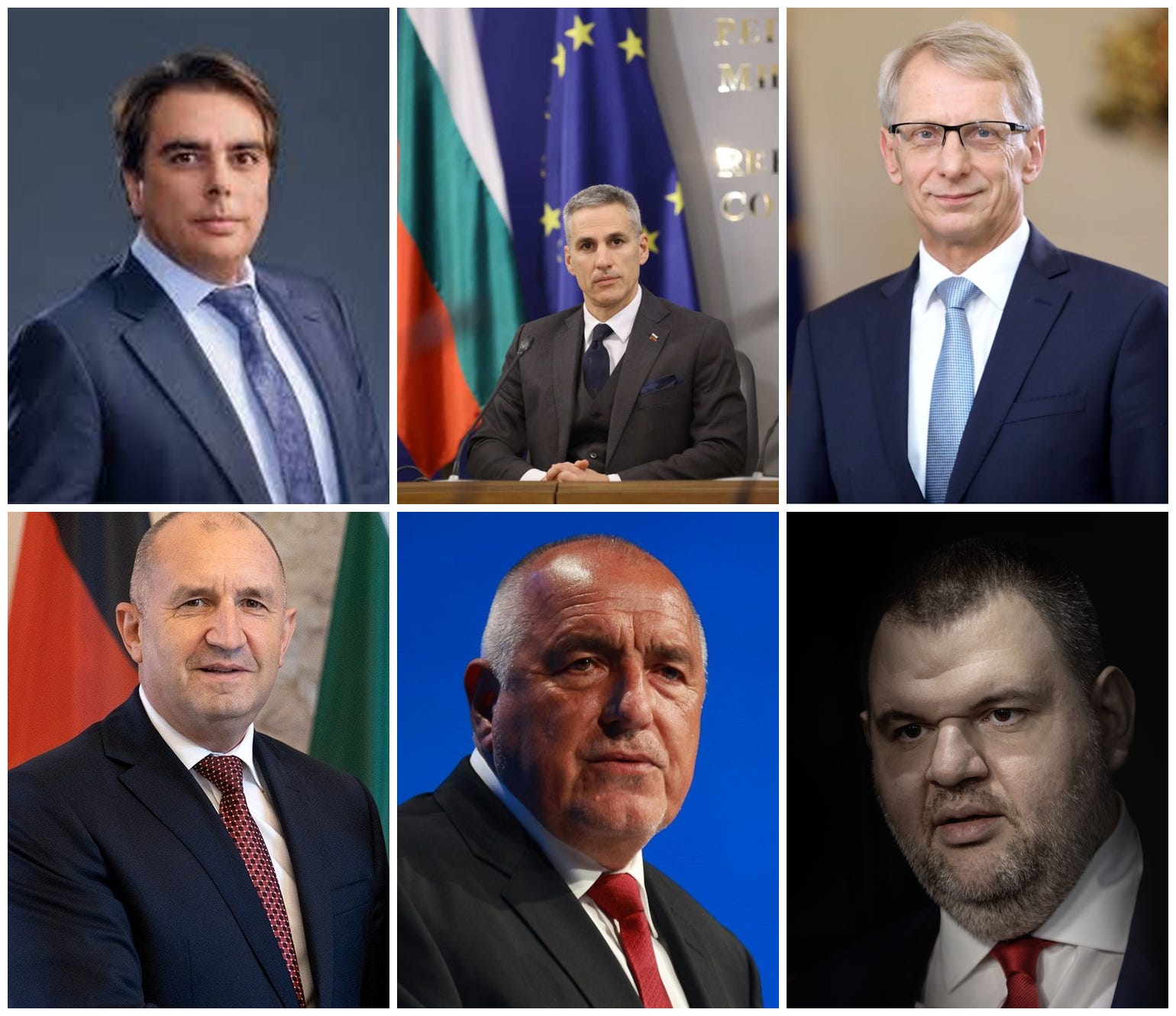
Let me walk you through the likely top four.
First place (projected): Rumen Radev’s Progressive Bulgaria coalition. Roughly 29-33% in the polls.
Radev spent 9 years as president saying absolutely nothing of substance. Zero. Zilch. A former fighter pilot and air force commander, he cultivated a “serious military man” aura while hedging on every issue that mattered enough to be quoted back to him later. Is he far-right? Centre-left? A Eurosceptic? A reformer? Ask 9 Bulgarians, get 11 answers. The ambiguity is the product - it is not a bug in his political personality; it is the entire personality.
What I know Radev actually is: a pro-Russian useful idiot who has learned to speak Bulgarian centrism fluently enough that a meaningful slice of the electorate genuinely cannot tell. He is also a coward. His positions are the positions of a man checking which way the wind is blowing, and adjusting his sails before anyone notices he has sails at all. Under normal circumstances, this would be a limitation. In Bulgarian politics, it is a competitive advantage.
Radev resigned the presidency in January 2026, several months before the end of his second term, to found a party and run for prime minister. The stated reason was a noble desire to “dismantle the oligarchic system.” The unstated reason is that presidential immunity expires, party-leader visibility does not, and there are ongoing questions about his involvement in certain energy-sector arrangements.
His candidate list is, charitably, uneven. Uncharitably, it ranges from the merely incompetent to the actively cognitively deficient. They will, if given the chance, wreck considerable havoc on Bulgaria’s domestic institutions. They will almost certainly not, however, do much damage at the EU level - but more on that in a moment, because it is the single most important thing I want you to take away from this essay.
Second place: GERB-SDS. Roughly 20%.
Boyko Borissov’s party. Boyko has been a three-time prime minister, a three-time ousted prime minister, Angela Merkel’s favourite lap dog in the Balkans during the 2010s, and is, by any reasonable measure, the most durable political operator the country has produced since 1989. GERB has never completed a full mandate. Every single government it has led has been brought down by protests, scandal or coalition collapse, and yet GERB keeps returning to office like a houseguest who does not recognise hints that he’s not welcome. It is, in the structural sense, a machine party - a collection of regional patronage networks held together by Borissov’s personal charisma and an industrial-scale tolerance for procurement irregularities. I will be polite and leave it there.
Third place: PPDB - We Continue the Change – Democratic Bulgaria. Roughly 11-12%.
The most adequate people in Bulgarian politics. Probably the only people in Bulgarian politics I would trust to read a spreadsheet. And the reward for being the adults in the room - for being, by Bulgarian standards, the governing-competence party - is a projected 12%. Three decades of democratic fragmentation have left the pro-European, pro-reform bloc trapped at roughly the same ceiling the anti-communist movement has had since the late 1990s.
Fourth place: DPS – New Beginning. Roughly 9-10%.
Led by Delyan Peevski - a man sanctioned under the US Magnitsky Act for corruption, a man whose commercial empire is rivalled only by his waistline, a man whose political longevity despite everything is perhaps the single strongest argument against the theory that Bulgarian democracy is self-correcting. If you need a visual, imagine a minor Ottoman pasha with a smartphone. There. You have met him.
And the rest, thrashing around the 4% threshold: Vuzrazhdane (”Revival”), the openly pro-Russian, anti-EU, anti-vaccine, anti-NATO party, running around 6-7%; the Socialists, possibly below threshold for the first time in the party’s post-1989 history, which is the closest thing to cosmic justice Bulgarian politics has offered in decades; and a rotating cast of vanity projects whose leaders’ names I refuse to memorise on principle.
The coalition arithmetic, or: why Sunday night does not end on Sunday
Radev is, per every poll, going to finish first. He is also, per every same poll, going to finish nowhere near 121 seats - the bare majority in a 240-seat parliament. He will therefore need a coalition. This is where the evening gets interesting, in the Chinese-curse sense.
Let us audit the options.
GERB? The establishment party Radev has spent his entire public career positioning himself against. A Radev-Borissov coalition would be a contradiction and it will be deeply unstable. Lifespan measured in days or weeks, if I am being generous.
PPDB? The reformers Radev and his people have spent years publicly loathing and insulting. Radev spent his second presidential term in low-grade trench warfare with the PPDB governments. A marriage here would require amnesia on both sides at a clinical level.
DPS – New Beginning? A Magnitsky-sanctioned coalition partner is - how do I put this - not ideal, even by Bulgarian standards, for a government that will need to raise financing on international markets and maintain EU funding eligibility.
Vuzrazhdane? The obvious ideological fit - pro-Russian meets pro-Russian, Eurosceptic meets Eurosceptic. The problem is that Kostadinov, their leader, has correctly calculated that being in opposition is more lucrative than being in government, and that Radev is going to eat his voter base anyway. Vuzrazhdane will pose for photos, demand the impossible and walk away.
In plain terms: there is no clean coalition here. There is, in fact, a high probability that no stable government is formed at all - that the mandate passes from Radev to Borissov to PPDB in the constitutional sequence, each of them fails to assemble 121 seats, and we return to the polls. Again. This has now happened so many times it has a choreography.
So fear not, my fretful Western friends. Even if Radev wins on Sunday - and he will - he may well be unable to form a government. And if he does form one, it will almost certainly not survive to its second Christmas. Elections will continue until morale improves.
Is there merit to Brussels panic?
Yes and no.
Yes, the situation is pretty depressing. No, it won’t have impact on the larger EU policies, because the odds of this government - assuming one even forms - surviving beyond the summer are relatively low.
The foreign press is already framing Sunday as the next catastrophe, which led many of my foreign friends and followers to reach out and ask for more context - Hungary has just rejected Orbán, they say, and now Bulgaria is about to pick up the fallen torch of the Kremlin’s European auxiliary. This framing is a bit premature, for three structural reasons.
First: whatever Radev gets on Sunday is his ceiling, not his floor. Bulgarian insurgent parties follow an arc so consistent you could set a clock to it. They emerge as the saviour of the moment. They surge to first place on a wave of disillusionment with whoever just failed. They govern badly - because saviour politics attracts competence-averse people. And within one or two electoral cycles, they cannot clear the 4% threshold. Ask ITN. Ask Velichie. Ask, for that matter, the Simeon II monarchist movement, which went from 42% in 2001 to electoral oblivion within a decade. Radev’s Progressive Bulgaria is not the exception to this pattern.
Second: Radev is a coward, and that is, for once, the good news. The probability that he tries to become a Bulgarian Orbán - frontally attacking EU institutions, weaponising the judiciary, picking open fights with Brussels over rule-of-law conditionality, vetoing Ukraine aid in European Council - is considerably lower than his campaign rhetoric suggests. Men who have spent 9 years refusing to take clear positions do not suddenly discover a taste for confrontation. He will grumble. He will give speeches about “sovereignty” and “peace” and the need for “balance.” He will conspicuously fail to attend certain photo opportunities. He will not, however, burn the house down. He likes the house. The house has good plumbing and an EU cohesion-fund tap.
Third - and this is the geoeconomic point I most want you to take seriously: the Bulgarian defence industry is booming and will not stop. The Burgas shell factories, the Sopot arsenal, the Kazanlak production lines - these are not running on ideology, but on order books. European and American buyers need Soviet-calibre ammunition in volumes Bulgaria uniquely can supply, and the margins are spectacular. A Radev government will talk a great deal about “peace” and “negotiated settlement” for domestic consumption. It will do essentially nothing to interfere with the export flows that keep Kazanlak employed and the balance of payments positive. The Petkov-Vassilev model of 2022 - plausible deniability via third-country intermediaries, with Poland and Romania as the cut-outs - is now fully institutionalised. It does not require a pro-Ukrainian government to function. It requires only a government that does not actively try to block it, and no Bulgarian government, however pro-Russian its rhetoric, is going to voluntarily destroy one of the genuinely profitable and competitive industrial sectors in the country. Follow the export data, not the press conferences of political pundits.
That is the Waronomics reading. Domestic politics in Bulgaria is a theatre of grievance. Also - Russian interference in Bulgarian politics has been self-evident from day one of this campaign, and nobody serious is surprised. Moscow has considered Sofia a client capital since the 1870s; tradition dictates that the Kremlin needs its input into Bulgarian elections the way an Italian grandmother needs her input into your outfit.
My Balkan Candor
Here is what I want you to hold in your head on Sunday night, when the exit polls come in and the Western newsrooms reach for the Orbán analogy and the Hungary comparison and the “another EU country lost” framing.
Bulgaria has been losing on the political scene for decades (arguably, since 1944). What the country has learned in that time is how to lose without losing completely. How to hold the outward forms of European liberal democracy while running a domestic politics that looks, close up, like a small, corrupt family business. How to deal with Russian pressure, Russian money, Russian propaganda and Russian political candidates - and nonetheless ship, on net, the ammunition that keeps Ukrainians alive. It is not a pretty adaptation, certainly not one I would recommend to anyone. But it is an adaptation, and it has kept the country, against considerable odds, inside the Western alliance system rather than outside it. Given our geographical and strategic significance, it is as important for us to be in the Western alliance as it is for the West.
When a generational shift occurs - and it will occur in due time - this course will likely change. As long as no major geopolitical shift occurs, things will be…okayish.
So to my Western readers panicking over the headlines on Sunday night: please, by all means, be concerned. But be concerned about the correct things. Be concerned about voter demoralisation, about Russian disinformation budgets, about the hollowing-out of the pro-European right. Do not be concerned that Bulgaria is about to become the next Hungary. Bulgaria is about to become, with remarkable consistency, exactly what Bulgaria has been for a decade: a country that votes badly, governs worse, and somehow keeps its passport.
One question before I go. If a country holds eight elections in five years and none of them produce a functioning government - at what point do we stop calling it a crisis and start calling it the system working as designed?

As a Hungarian, you are saying alll the things we have always thought about Bulgarian politics!
Thank you so much a very good insight in my opinion. Especially now that the outcome is available, to look at it in this perspective, the situation is somehow more acceptable. Or, the very high percentage for the winner's votes may become a source of trouble? And my questions rises exactly from the comments I have read so far that Bulgaria is now the new Hungary. Thank you very much!